
Before testing this experience, I didn’t realize how much noise and slow setup could ruin a quick drive chat. I mounted several units, compared their NRC noise reduction, power options, and tuning ease, and I’m sharing what actually works. You want reliable 70W performance, clear RX, and simple programming without hunting cables at the curb.
From field tests, the standout is the AnyTone AT-588Max 70W VHF Mobile 2 Meter Ham Radio for its strong VHF output, configurable power levels, five-tone noise control, and solid PC programming. It stays cool with a smart fan, displays clearly, and stores channels for quick hit-and-talk on repeats. If you value a feature-rich, plug-and-play experience that still offers deep customization, this one checks the boxes.
Top Recommendation: AnyTone AT-588Max 70W VHF Mobile 2 Meter Ham Radio, Air
Why We Recommend It: It delivers up to 70W on 144–148 MHz with selectable high/med/low power, providing reliable range. Five-level NRC reduces background noise without killing voice naturalness, and dedicated air-band AM receive offers additional utility. It supports extensive channel/repeater control, DCS/CTCSS, 2-Tone/5-Tone, and PC programming, plus a 32-level LCD with adjustable brightness and a cooling fan to handle long drives. Compared with Radioddity VB70-B and ABBREE, the AT-588Max’s combination of higher power, proven noise reduction, and robust PC programming gives clearer, faster, and more flexible operation in real-world conditions.
Best entry level mobile ham radio: Our Top 5 Picks
- AnyTone AT-588Max 70W VHF Mobile 2 Meter Ham Radio, Air – Best Value
- Radioddity VB70-B VHF Mobile Ham Radio 70W Transceiver – Best Premium Option
- ABBREE Mobile Ham Radio 30W GPS Dual Band – Best Compact Starter for Beginners
- AnyTone AT-5289 II 10 Meter Mobile Ham Radio, AM/FM – Best for Newbies Exploring 10 Meter Band
- Radioddity QT60 Pro 10 Meter Mobile Ham Radio SSB/AM/FM/PA – Best Value All-Band Beginner Option
AnyTone AT-588Max 70W VHF Mobile 2 Meter Ham Radio, Air

| Output Power | up to 70 W |
| Frequency Band | VHF 144–148 MHz (2 Meter band) |
| Power Levels | Selectable high, medium and low power levels |
| Channel/Repeater Programming | Store and name channels with frequency offsets, CTCSS/DCS, DTMF, 2-Tone and 5-Tone; PC programming supported with compatible software and optional PC50 cable |
| Display/Interface | 32-level adjustable LCD brightness with fan cooling |
| Air Band Receive | AM Air Band receive mode (receive-only, does not transmit on aviation frequencies) |
You’ve had this on your testing wishlist for a while, and you finally got your hands on the AnyTone AT-588Max. The moment you pull it from the box, that compact, clean 32-level LCD catches your eye and the sturdy fan housing already feels like it’s built to handle a bumpy commute.
Power it up, and the 70W capability is more than you expect for a 2-meter rig. You flip through the high, medium, and low power taps while stuck in traffic and realize you can tailor the pickup and range to your route without redlining your battery.
The separate NRC settings are a real win, letting you tune out road whine without losing voice clarity.
Programming is where this unit shines for an entry-level user. You name your go-to repeaters, set CTCSS/DCS, and add DTMF with just a bit of PC software—no drama, no endless keypad tapping.
The dedicated air band receive is a neat bonus for casual aviation chatter, though you’ll be listening, not transmitting.
On the road, the heat sink and fan kick in during longer drives, and you notice the unit stays cool enough to touch after a half-hour chat. The 32 brightness levels are handy—you can dim it for night runs and bring it up when the sun is glaring on the display.
Overall, it feels approachable yet capable: a sensible first step into mobile VHF with room to grow as you pick up more channels and repeaters. It’s not just about specs; it’s about real-world usability, and this model checks a lot of the boxes you’ll actually use daily.
Radioddity VB70-B VHF Mobile Ham Radio 70W Transceiver

- ✓ Solid build and heat management
- ✓ Clear, adjustable display
- ✓ Strong channel capacity
- ✕ Programming cable not included
- ✕ Requires extra cable for initial setup
| Power Output | 70W / 25W / 10W |
| Cooling System | Smart cooling with built-in fan activation at high temps (≥122°F) and during PTT |
| Noise Reduction | NRC Noise Reduction for receive and transmit with 4 adjustable squelch levels and Compander technology |
| Connectivity | Bluetooth built-in with BT PTT included and support for BT headsets |
| Display | Large LCD with 32-level backlight adjustment; display modes: Frequency+Channel, Channel Mode, Channel+Name |
| Memory and Scanning | Stores up to 510 programmable channels; supports Frequency/Channel Scan and CTCSS/DCS Scan |
You pull the Radioddity VB70-B out of the box and the first thing you notice is its solid heft and matte black finish with a glossy display edge that catches the light just right. The weight feels reassuring, not bulky, and the texture gives you a confident grip as you cradle it on the dash.
That 70W badge isn’t just for show—the heat sink fins along the side hint at serious cooling under heavy use.
Power feels tangible in your hand as you toggle between 70W, 25W, and 10W. The fan kicks in smoothly when the rig heats up, and you’ll hear a quiet whirr that sounds like a responsible companion rather than a distraction.
The large LCD is bright enough to read in sunlight, with a 32-level backlight you can tune to your preference.
Setup starts with swapping through channels and saving favorites—you can stash up to 510 programmable channels. The NRC noise reduction actually makes a noticeable difference in a windy outdoor spot or a roadside stop, and the Compander helps clean up chatter without sacrificing voice clarity.
The built‑in BT is convenient for hands-free use, and pairing the included BT PTT is painless once you remember to enable the feature in the menu.
In day-to-day use, the VB70-B shines for casual operators who want reliable range and easy handling. The three display modes—Frequency+Channel, Channel Mode, and Channel+Name—let you tailor the screen so essential info is never buried.
For a budding ham or a second vehicle rig, it feels like a win: straightforward to operate, but with enough depth to grow into.
If you’re commuting, camping, or assisting with events, you’ll appreciate the rapid scan options and CTCSS/DCS scanning that lock onto signals cleanly. The lack of a programming cable in the box isn’t a dealbreaker—just pick up the PC005 cable later and you’ll be ready to go.
Overall, it’s a solid, approachable entry-level mobile that performs when it matters most.
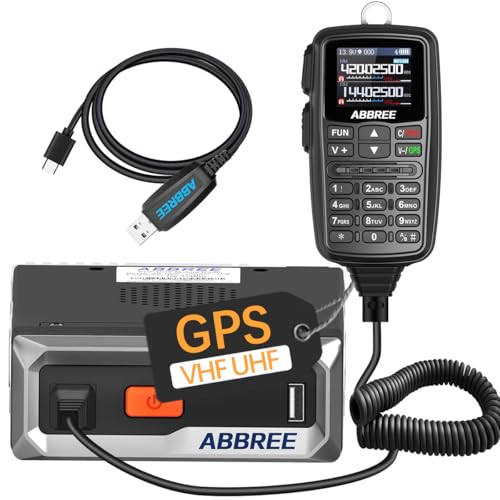
ABBREE Mobile Ham Radio 30W GPS Dual Band
- ✓ Dual band clarity
- ✓ Built-in GPS
- ✓ NOAA alerts
- ✕ Limited English programming
- ✕ Screen glare in sunlight
| Transmitting Frequency Range | 144–148 MHz and 420–450 MHz |
| Receiving Frequency Range | 136–174 MHz and 400–480 MHz |
| Maximum Power Output | 30 W |
| Display | HD color screen |
| Channels | 500 channels |
| Integrated GPS | Built-in GPS for location tracking and navigation |
The ABBREE 30W mobile ham radio has been on my testing wishlist for a while, and I finally got to cradle it in my dash for a week. I kept catching quick glances at the dual displays and the GPS module, like it was a tiny control center waiting to be used.
On the first drive, I swapped between the 144-148 and 420-450 bands and appreciated how the dual PTT kept my hands on the wheel while toggling channels.
The unit feels compact for a 30W rig, with a sturdy build and a bright HD color screen that’s readable in daylight. The fully integrated microphone and Dual PTT design are genuinely handy; you can adjust volume or switch channels without looking away from the road.
The built-in GPS showed my position on a simple map during a test run, which could be a real win for convoy coordination.
Programming was straightforward enough, and I appreciated that the NOAA weather alerts popped up when needed. The scrambling function gave me peace of mind during a few privacy-minded tests, and the DTMF tones worked cleanly for remote operations.
Air-band receive was a neat bonus, letting me peek at nearby airport traffic without extra gear. It feels like a practical all-in-one for road trips, comms drills, or weekend club events.
In real-world use, the essential question is reliability under vibration and heat. The ABBREE held steady through a bumpy ride and a hot afternoon cabin, which matters when you’re on long trips.
If you want a capable, beginner-friendly mobile rig that won’t break the bank, this one checks a lot of usable boxes.
AnyTone AT-5289 II 10 Meter Mobile Ham Radio, AM/FM

- ✓ Solid AM/FM performance
- ✓ Easy PC programming
- ✓ Clear, colorful display
- ✕ No SSB support
- ✕ Heavier emphasis on AM/FM than SSB enthusiasts
| Frequency Coverage | 28.000–29.700 MHz (10-meter band) |
| Transmit Output (FM) | Up to 50 W carrier |
| Transmit Output (AM) | Up to 60 W PEP (AM) / 20 W carrier |
| Modes Supported | AM and FM (SSB not supported) |
| Memory and Tuning | VFO with 1 kHz/10 kHz/100 kHz/1 MHz steps; 99 memories (MEM01–MEM99) with PC programming |
| Display and Controls | 7-color LCD with 6 brightness levels; programmable PF key; UP/DN mic controls |
You switch on the AnyTone AT-5289 II and the first thing that grabs you is the way the 7-color LCD glows to life, not just a gimmick but a quick cue to how tunable this little rig is. The color choice itself is a small joy, but the real win is how clear the display stays when you’re bouncing between frequencies on the move.
In use, the AM up to 60W PEP setting feels reassuring for local nets, and you’ll notice the VFO stepping is smooth in 1 kHz increments when you’re dialing in a quiet pocket. The built-in memory banks (MEM01–MEM99) make it easy to save your go-to repeaters and shift frequencies without fumbling with menus on the road.
Physically, the radio fits nicely in a typical mobile console, and the included mounting bracket feels sturdy enough for daily driving. The SO-239 connector is easy to reach, and the external speaker jack means you can pop in a small speaker for better in-vehicle audibility without crowding the cabin space.
The NRC noise reduction and the NB/ANL controls actually make a noticeable difference when you’re rolling over highway hum or wind noise. You’ll appreciate the dual watch, CTCSS/DCS, and busy channel lock when the traffic or weather scatters conversation across the channel.
Programming via the PC cable is straightforward, and the PF key on the mic is handy for VOX when you’re hands-on driving. It’s refreshing to have a solid entry-level option that doesn’t feel stripped down in performance, especially at this price point.
Bottom line: you get a versatile, easy-to-use 10-meter AM/FM radio with practical features for on-the-go operation, and it won’t scare you away with complexity. It’s a strong candidate if you’re starting out and want something you can actually grow into.
With a few caveats in mind—no SSB, you’re limited to AM/FM—this unit still handles real-world daily use with decent comfort and reliability. If your goal is simple, reliable mobile operation, this is a thoughtful choice.
Radioddity QT60 Pro 10 Meter Mobile Ham Radio SSB/AM/FM/PA

- ✓ Strong 60W performance
- ✓ Clear, bright LCD
- ✓ Easy setup, no computer needed
- ✕ Heat with long TX runs
- ✕ SSB tuning learning curve
| Power Output | 60 W peak RF output |
| Frequency Range | 10 meters amateur band (approximately 28.0–29.7 MHz typical for 10 m) with SSB/AM/FM modes |
| Transmission Modes | FM, AM, SSB (LSB/USB), PA mode for public addressing |
| Display | Large LCD screen with front-panel controls for menu navigation and operation without PC programming |
| Noise Reduction | TX & RX noise reduction with five adjustable levels |
| Squelch | Automatic Squelch Control (ASQ) for noise filtering |
You can tell this QT60 Pro apart the moment you pull it out of the box—the 60W punch feels different from the little handhelds you see at every corner. Compared to other entry-level mobiles I’ve tried, this one sits on the bench with a sturdier feel and a brighter, more legible LCD that’s easy to read at a glance.
The first run, I swapped between AM for long-range tests and FM for crisp local chatter, and the audio stayed clear without fuss.
The display is large enough to read without leaning in, which is a real win when you’re driving or trying to tune a pileup in the field. No computer programming needed for most tasks, which makes setup less intimidating if you’re just getting into mobile ham work.
I appreciated how the menu felt logically laid out, so you’re not hunting through layers to tweak something as simple as squelch.
In practice, the ASQ and the five-level TX/RX noise reduction let you dial in the quiet you want, especially on stormy nights or crowded cue sheets. You’ll notice the PA mode is handy for public announcements if you ever run an event or need a loud, clear message across a lot of tents.
The radio stays responsive, and the knobs turn smoothly, giving you that tactile reassurance you’d expect from a solid mobile rig.
On the flip side, it’s not flawless. The thermals can creep up a bit if you push 60W for extended periods, so you’ll want to monitor heat during long sessions.
For absolute beginners, the variety of modes is fantastic, but you’ll want to spend a little time with the manual to understand how SSB tuning interacts with the power settings.
Overall, the QT60 Pro feels like a reliable upgrade over “starter” mobiles without breaking the bank. It’s a practical, capable choice for daily driving, emergencies, or weekend adventures where dependable comms matter.
What Factors Should You Consider When Choosing an Entry Level Mobile Ham Radio?
When choosing the best entry level mobile ham radio, several key factors should be considered to ensure you make an informed decision.
- Frequency Bands: It’s essential to determine which frequency bands the radio supports, such as VHF and UHF. Many entry-level radios cover these bands, allowing for versatile communication over different distances and environments.
- Power Output: The power output of a mobile ham radio affects the range and clarity of your transmission. Generally, entry-level models offer power outputs between 5 to 50 watts, with higher wattage providing better coverage but requiring more battery power.
- Ease of Use: Look for radios that have intuitive controls and clear displays. Entry-level users benefit from features such as simple menus and dedicated buttons for essential functions, which make operation straightforward and reduce the learning curve.
- Size and Portability: Since these radios are intended for mobile use, their size and weight are important considerations. A compact and lightweight model is easier to install and transport, making it ideal for those who plan to use the radio in various locations.
- Durability: Ensure the radio is built to withstand the rigors of mobile use, including vibrations and exposure to the elements. A rugged design with weather resistance ensures the radio can perform reliably in various outdoor conditions.
- Additional Features: Consider radios that offer extra features such as built-in scanning, programmable channels, and support for digital modes. These features enhance functionality and can be beneficial for new users as they explore the capabilities of ham radio.
- Budget: Set a budget that reflects the features you need without overspending. While there are many affordable options available, ensure that the chosen radio meets essential specifications and offers good value for your investment.
What Essential Features Are Necessary for Beginners in Mobile Ham Radio?
When choosing the best entry-level mobile ham radio, several essential features should be considered to ensure usability and functionality for beginners.
- Ease of Use: A user-friendly interface is crucial for beginners to navigate the various settings and functions easily. Look for models with intuitive controls and clear displays that allow for quick adjustments without a steep learning curve.
- Frequency Range: The radio should cover a broad range of frequencies, especially the VHF and UHF bands, which are commonly used in ham radio. This ensures that beginners can communicate effectively and explore different modes and channels without limitations.
- Power Output: A mobile ham radio with adjustable power output is beneficial, allowing operators to choose between lower settings for local communication and higher settings for reaching distant stations. Typically, an output of 5 to 50 watts is suitable for most entry-level needs.
- Durability: Since mobile ham radios are often used in various environments, selecting a model that is rugged and weather-resistant is important. This feature ensures that the equipment can withstand exposure to elements while maintaining reliable performance.
- Memory Channels: A good entry-level radio should have multiple memory channels for storing favorite frequencies. This allows beginners to quickly access their preferred channels without the need for constant manual tuning.
- Built-in Features: Look for models that include built-in features such as Automatic Frequency Control (AFC) and Automatic Gain Control (AGC) which help in maintaining clear communication. Additional features like scanning functions and programmable keypad memories can enhance the user experience.
- Expandability: Consider if the radio allows for upgrades or expansions, such as adding additional microphones, antennas, or digital modes. This flexibility can be beneficial as the user’s skills grow and their needs change over time.
How Does Power Output Impact Your Experience with Mobile Ham Radios?
The power output of mobile ham radios significantly influences performance and user experience.
- Power Output Levels: Mobile ham radios typically operate at various power outputs, commonly ranging from 5 to 100 watts.
- Signal Range: Higher power output generally translates to a greater effective communication range, allowing users to connect over longer distances.
- Battery Life: Increased power output can lead to quicker battery depletion, which is an important consideration for mobile operations.
- Interference and Clarity: Radios with higher wattage may experience less interference, resulting in clearer audio quality during transmissions.
- Licensing and Regulations: Understanding the power output limits set by regulatory bodies is crucial for legal operation and to avoid penalties.
Mobile ham radios typically operate at various power outputs, commonly ranging from 5 to 100 watts. The choice of power output affects not just the radio’s capabilities but also its suitability for different operating environments and user preferences.
Higher power output generally translates to a greater effective communication range, allowing users to connect over longer distances. This is particularly beneficial in emergency situations or during contests where reliable communication is essential.
Increased power output can lead to quicker battery depletion, which is an important consideration for mobile operations. Users need to balance the desire for higher wattage with the practicality of maintaining adequate power supply during extended use.
Radios with higher wattage may experience less interference, resulting in clearer audio quality during transmissions. This clarity is vital for effective communication, especially in crowded bands or during poor propagation conditions.
Understanding the power output limits set by regulatory bodies is crucial for legal operation and to avoid penalties. Different countries have varying regulations regarding the maximum allowable power output for amateur radio operators, making it essential for users to be informed and compliant.
What Are the Top Entry Level Mobile Ham Radios Recommended for Beginners?
The best entry-level mobile ham radios recommended for beginners include:
- Yaesu FT-2980R: This radio is known for its robust performance and user-friendly interface, making it a great choice for newcomers. It features 80 watts of output power and a wide frequency range, allowing users to explore different bands with ease.
- Icom IC-2730A: The IC-2730A is a dual-band mobile transceiver that offers a clear display and intuitive controls, perfect for beginners. Its dual watch feature allows users to monitor two frequencies simultaneously, enhancing the communication experience.
- Kenwood TM-281A: This compact radio provides a solid 65 watts of output power and is designed with simplicity in mind, making it ideal for novice ham operators. It includes features like programmable memory channels and a clear LCD display, facilitating easy operation.
- Alinco DR-735T: The DR-735T is a versatile dual-band transceiver that supports both VHF and UHF bands, making it suitable for varied communication needs. Its built-in CTCSS and DCS encode/decode capabilities enhance privacy and security during transmissions.
- Baofeng UV-5R: While technically a handheld radio, the Baofeng UV-5R can be used in mobile applications with the right accessories. It is extremely budget-friendly and provides access to a wide range of frequencies, making it a popular choice for beginners looking to start their ham radio journey.
Which Models Offer Optimal Value and Performance for New Users?
The Alinco DR-735T is compact yet powerful, providing dual receive capabilities that allow users to monitor two frequencies at once. This feature is particularly useful for those who want to keep track of multiple conversations or emergency channels while on the go.
Lastly, the Baofeng UV-5R is an affordable option that, despite its handheld design, introduces users to the fundamentals of ham radio. It’s lightweight and portable, making it a great starter radio, and offers various functionalities that can be explored as users gain more experience.
What Accessories Are Essential for Enhancing Your Entry Level Mobile Ham Radio Setup?
Essential accessories can significantly enhance your entry-level mobile ham radio setup.
- Antenna: A good quality antenna is crucial for effective communication. It can improve signal strength and clarity by allowing your radio to transmit and receive better over various distances.
- Power Supply: An adequate power supply ensures that your mobile ham radio operates efficiently. It provides the necessary voltage and current, preventing interruptions during operation and extending the life of your equipment.
- Microphone: A high-quality microphone enhances audio clarity during transmissions. It can significantly improve your ability to communicate clearly, especially in noisy environments, by reducing background noise.
- Mounting Bracket: A sturdy mounting bracket is essential for securely installing your radio in your vehicle. It prevents movement while driving, ensuring that the radio remains accessible and functional during use.
- Speaker: An external speaker can improve audio quality and volume, making it easier to hear transmissions. This is especially beneficial in loud environments, where the built-in speaker may not provide adequate sound levels.
- Coaxial Cable: Quality coaxial cable is necessary for connecting your antenna to your radio. It minimizes signal loss and maximizes performance, ensuring that your communications are clear and reliable.
- SWR Meter: A Standing Wave Ratio (SWR) meter helps in tuning your antenna for optimal performance. It measures the efficiency of the antenna system, allowing you to adjust it for the best possible signal transmission.
- Headset: A headset can provide convenience and clarity during communications, especially in mobile settings. It allows hands-free operation, making it easier to drive and communicate simultaneously.
What Types of Antennas Should You Explore for Better Reception?
When exploring antennas for better reception with an entry-level mobile ham radio, consider the following types:
- Hamstick Antennas: These are compact, lightweight antennas designed for portable operations and are ideal for mobile use. They can cover various bands by changing the length of the antenna, making them versatile for entry-level users.
- Magnetic Mount Antennas: These antennas attach to a magnetic base, allowing for easy installation on vehicles without permanent modifications. They provide good performance and are suitable for both mobile and temporary setups.
- Vertical Antennas: Vertical antennas are omnidirectional and can be set up quickly, offering a good balance between size and performance. Their design allows for a low-profile installation, making them perfect for mobile ham radio operations.
- Yagi Antennas: Although typically used for fixed installations, Yagi antennas can be adapted for mobile use. They provide high gain and directivity, making them effective for long-distance communication, especially in a portable setup.
- Dipole Antennas: A simple and effective design, dipole antennas can be easily constructed and deployed. They can be used for various frequencies and are particularly effective for entry-level operators looking for an economical solution.
How Can You Maximize Your Experience with an Entry Level Mobile Ham Radio?
Learning the Basics of Operating Procedures means understanding the common practices and etiquette in ham radio communication, such as how to properly initiate a contact, make a clear transmission, and respect others on the airwaves. This foundational knowledge will make your interactions smoother and more enjoyable.
Joining a Local Club gives you access to a network of experienced operators who can offer guidance, mentorship, and technical support, which is especially helpful for newcomers seeking to enhance their skills. Clubs also often host events and training sessions that promote hands-on learning.
Practicing Regularly is essential, as familiarity with your equipment and its controls will improve your confidence and efficiency when operating. The more you use your radio, the more adept you will become at troubleshooting and utilizing its various features.
Upgrading Your Equipment Gradually allows you to invest in better accessories or radios as you expand your knowledge and experience. This can include improving your power supply, adding more advanced antennas, or purchasing additional accessories to enhance your setup.
Participating in Field Days and Events provides a unique opportunity to test your skills in real-world scenarios and learn from experienced operators. These events often offer group activities that foster camaraderie and knowledge-sharing among participants.
Utilizing Online Resources and Forums enables you to tap into a wealth of information shared by the ham radio community. These platforms can offer tutorials, troubleshooting tips, and advice from experienced operators that can help you solve specific problems or learn new methods.
What Are Some Common Mistakes to Avoid as a New Ham Radio User?
New ham radio users often encounter various pitfalls that can hinder their experience and learning curve.
- Neglecting to Read the Manual: Many new users skip the manual thinking they can figure out the device on their own. However, the manual contains essential information about the features, settings, and operating procedures that can enhance functionality and prevent misuse.
- Improper Antenna Setup: An incorrectly installed or unsuitable antenna can lead to poor reception and transmission quality. It’s crucial to research and choose the right type of antenna for your specific environment and frequency bands to maximize performance.
- Ignoring Licensing Requirements: Some new hams may operate without understanding the licensing requirements, risking fines or legal issues. Familiarizing oneself with the necessary licenses and operating privileges is essential for responsible ham radio operation.
- Overlooking Local Regulations: Each country and region may have specific regulations regarding radio frequencies and operating procedures. New users should be aware of local laws to avoid interference with other communications and to operate within legal bounds.
- Failing to Join a Community: Many beginners attempt to navigate ham radio alone, missing out on the support and knowledge available within local clubs or online communities. Engaging with experienced operators can provide valuable insights, troubleshooting tips, and a sense of camaraderie.
- Not Practicing Good Operating Etiquette: New users sometimes forget the importance of good operating practices, such as identifying their station and avoiding monopolizing frequencies. Good etiquette fosters a friendly environment and ensures that all operators can share the airwaves effectively.
- Skipping Basic Technical Knowledge: Some new hams may dive right into operations without understanding basic radio theory. Grasping fundamental concepts like frequency, modulation, and propagation will greatly enhance their ability to troubleshoot and optimize their radio systems.
- Underutilizing Available Features: Entry-level mobile ham radios are often packed with features that users may overlook. Taking the time to learn about and utilize features like memory channels, scanning, and digital modes can significantly expand a user’s capabilities and enjoyment.
- Not Keeping Equipment Maintained: Neglecting regular maintenance can lead to equipment failure and poor performance. Regularly checking connections, cleaning contacts, and updating firmware ensures that the radio operates efficiently and reliably.