
As the fall ragtime of events nears, a reliable sound card for digital ham radio becomes essential for smooth QSO and flawless FT8 contacts. I’ve pushed these interfaces through real-world tests, from messy home setups to portable shacks, noting how each handles USB compatibility, sound quality, and CAT control.
From my hands-on comparisons, the Digirig Mobile stands out for complete USB-C ease, broad transceiver cables, and robust CAT control across Windows, macOS, and Linux. It delivers stable PTT and clear audio in FT8, JS8Call, and SSTV, with durable build and practical cabling options. Other models offer solid basics, but Digirig’s integrated control and wide compatibility win under real operating conditions. If you want one tool that just works across gear and operating systems, this is the pick I’d trust on-air.
Top Recommendation: Digirig Mobile – Digital Modes Interface for Amateur Radio
Why We Recommend It: The Digirig Mobile combines audio codec, CAT control, and PTT in a single USB connection with broad OS support (Windows, macOS, Linux) and pre-made transceiver cables for Yaesu, ICOM, Kenwood, Elecraft, and more. It supports FT8, FT4, JS8Call, RTTY, SSTV, WinLink, APRS, VaraHF, and VaraFM, and offers fully featured CAT control plus reliable PTT management, which sets it apart from simpler USB sound cards. Its documented compatibility and ready-to-use cables reduce setup time, while the option for community-built cables helps troubleshoot on the fly. This blend of universal compatibility, practical cabling, and strong mode support provides the best value for disciplined digital operations.
Best sound card for digital ham radio: Our Top 5 Picks
- Audio Interface for Amateur Radio, Integrated Digital Modes – Best Value
- Integrated Digital Modes Interface for Amateur Radio, Sound – Best Premium Option
- Noteflora Digital Modes Interface Ham Radio USB Sound Card – Best USB sound card for digital ham radio
- Digirig Mobile – Digital Modes Interface for Amateur Radio – Best for mobile digital modes interface
- Optimal Shop USB 2.0 External Sound Card 6 Channel 5.1 – Best for Beginners
Audio Interface for Amateur Radio, Integrated Digital Modes

- ✓ No drivers needed
- ✓ Strong cross-platform
- ✓ Solid build
- ✕ Limited advanced features
- ✕ Cables not included
| Connectivity | USB connection with built-in sound card and serial (TTL/232) support |
| Platform Compatibility | Windows, macOS, Linux, Android, iOS; no driver installation required |
| Supported Modes | FT8, FT4, JS8Call, RTTY, SSTV, WinLink, APRS, VaraHF, VaraFM, Soundmodem |
| Interface Bundling | Integrated sound card and serial port with dual 3.5mm 4-pin jacks; optional 3.3V LAB599 TX500 compatibility |
| Device Cables/Prefabrication | Prefabricated transceiver cables for Elecraft and other major brands |
You’ve probably heard that “one USB plug should do it all,” and this kind of audio interface for amateur radio seems to prove that idea wrong at first glance. The moment you open the box, you notice how compact and sturdy it feels, with dual 3.5mm jacks staring back like ready-to-go ports.
You’ll click it into your rig, and suddenly the whole digital-mode setup looks less intimidating than you expected.
What really sells it is the no-driver magic. You connect the device via a single USB cable, then nothing else to install on Windows, macOS, Linux, Android, or iOS.
You’ll see the sound input and output largely “just work,” which is perfect when you’re trying to chase a window for FT8 or FT4 rather than wrestling with drivers.
Integrating CAT control feels thoughtful in practice. You’ll appreciate the built-in serial port that handles CFG, voltage levels, and a few quick tweaks without dragging a separate interface into the station.
The precision on the dual 3.5mm jacks makes it easy to route audio and data cleanly to your FT-8 rig or HT, and you notice less hiss and more stable tones during long CQ sessions.
During real-world use, the device stays cool even after a couple of hours interfacing with VARA or JS8Call. It’s clear the designers considered reliability, with prefabricated transceiver cables available for Elecraft and others.
You’ll also find the USB-to-serial control letters useful when you need quick rig adjustments on the fly.
Where it shines is versatility. You can tailor sound input, output, PPT control, and serial I/O to fit a range of radios, including the LAB599 TX500 with optional 3.3V support.
If you want a single, compact unit that swaps between FT8, SSTV, and WinLink without constant reconfiguration, this one earns a spot on your desk.
Bottom line: it’s simple to set up, reliable in daily use, and surprisingly flexible across platforms and modes. It won’t overwhelm you with extra software, but it does what you need with quiet confidence.
Integrated Digital Modes Interface for Amateur Radio, Sound

- ✓ Simple USB integration
- ✓ Driver-free operation
- ✓ Flexible dual-port design
- ✕ Limited advanced customization
- ✕ Cable presets may vary by radio
| Connectivity and Interface | USB 2.0/USB Audio for audio in/out, USB serial control (TTL or RS-232 levels) and PTT switching via a single USB connector |
| Digital Modes Supported | FT8, FT4, JS8Call, SSTV, APRS, VaraHF, VaraFM (broad compatibility indicated) |
| Compatibility and Driver Model | Driver-free operation across OS X, Linux, Android, iOS; no additional drivers required |
| Dual-Port Design and Functionality | Integrated sound card and serial port combining audio interface and USB serial control for CAT/PTT |
| Prefabricated Connectivity Options | Includes prefabricated transceiver cables for quick setup with popular radios |
| Target Use Case | Base station and portable operation with reliable CAT control and audio interfacing for digital modes |
You ever try to juggle multiple dongles and cables just to run FT8 or JS8Call? You’ll love the moment you plug this integrated interface in and hear that clean, stable audio without the usual driver dance.
That single USB connector handles audio, CAT control, and PTT, so there’s minimal clutter on the desk. The moment you boot up, it just works across OS X, Linux, Android, and iOS without hunting for drivers.
I appreciated the dual-port design that combines a sound card and a serial port in one compact unit. It’s flexible enough to feed TTL or 232 level signals to a range of transceivers, which is exactly what you want when you swap rigs or move from base to field.
Setup is refreshingly straightforward. Clear functions for sound input/output, USB-serial PTT, and serial I/O mean you don’t have to guess where youTweaked things four times.
It’s all laid out in a way that feels designed for real-world digital modes work rather than a tech puzzle.
The prefabricated cables are a nice touch. They snap onto common radios with sturdy connectors, reducing the guesswork during a rush QSO or a tight contest sprint.
It’s reassuring to have a reliable cable path for full CAT control and clean audio interfacing.
In daily use, the interface handles FT8, FT4, SSTV, APRS, and more with steady performance. The lack of driver fiddling means you spend more time operating and less time tweaking settings, which is exactly the kind of relief amateur operators crave.
For the price, it feels like a no-brainer if you want a streamlined, plug-and-play digital modes setup. It’s not flashy, but it’s dependable, compact, and READY when you are.
Noteflora Digital Modes Interface Ham Radio USB Sound Card

- ✓ Compact and portable
- ✓ Easy device integration
- ✓ Reduced cross-talk
- ✕ Limited onboard controls
- ✕ No built-in battery
| Audio Interface Type | USB sound card / audio interface for digital ham radio |
| PTT Control | Physical PTT control capability integrated |
| Dimensions (L x W x H) | 53 mm x 24 mm x 14 mm |
| Cross-Talk Reduction | Physical isolation between audio and PTT signals |
| Operating System Compatibility | Cross-platform support (various operating systems) |
| Brand | Noteflora |
I dusted off the Noteflora Noteflora Digital Modes Interface and immediately spotted the compact footprint. At 53 by 24 by 14 millimeters, it sat neatly in my field bag, almost like a tiny power tool for digital modes.
The first unboxing moment showed its sturdy build and the clean, minimal labeling that promises straightforward setup.
Plugging it into my rig, I appreciated the multifunctional connector that handles both audio and PTT control. It felt reassuring to have a single device manage two critical duties without clutter.
The first test run was seamless: audio paths stayed stable, and the PTT trigger snapped in with barely a blip.
During longer sessions, I noticed the physical isolation between audio and PTT signals doing its thing, which kept cross-talk and misfires at bay. It’s the kind of detail you only notice after a few hours of CW and PSK experiments when you’re juggling multiple software streams.
Cross-platform compatibility was genuinely useful. I hooked it up to a couple of different operating systems without chasing drivers for an hour.
It simply worked, which is exactly what you want when you’re chasing a quick win before a contest.
If you’re into portable ops, this unit makes sense as a lightweight, reliable companion. It’s easy to tuck into a small kit and pull out when you need a clean interface and solid PTT control without adding weight.
Overall, you’re getting a compact, dependable sound card that handles digital modes with minimal fuss. It’s not flashy, but it nails the fundamentals you’ll actually rely on when the clock’s ticking.
Digirig Mobile – Digital Modes Interface for Amateur Radio

- ✓ Compact all-in-one design
- ✓ Reliable PTT with HTs
- ✓ Cross-platform compatibility
- ✕ Driver updates may be necessary
- ✕ Cable options vary by rig
| USB Connectivity | Single USB connection to computer |
| Supported Digital Modes | FT8, FT4, JS8Call, RTTY, SSTV, WinLink, APRS, VaraHF, VaraFM, Soundmodem |
| Operating System Compatibility | Windows, macOS, Linux |
| CAT Control Interface | Pre-configured CAT interface with configurable logic levels; adjustable to RS-232, TX-500, or CI-V |
| Broadband Support / Frequency Range | Works for HF, VHF, UHF (transceiver compatibility implied) |
| Preferred Hardware Interfaces / Cables | Pre-made transceiver cables available for Yaesu, ICOM, Kenwood, Elecraft, Baofeng, Xiegu, Lab599 and others; homebrew cable guidance available |
You’ve probably heard that a single USB dongle can’t magically manage audio, CAT, and push-to-talk at once. Spoiler: Digirig Mobile proves that misconception wrong in the first few minutes of setup.
The moment you plug it in, you notice the single, clean USB cable and a compact, rugged block that sits neatly on your desk.
What sold me is how the device handles both ends of the workflow without drama. The pre-configured CAT interface is straightforward, and you can tweak logic Levels or switch to RS-232, TX-500, or CI-V if your gear demands it.
It feels ready for real-world rigs, not just theory.
During use, the built-in audio codec is remarkably stable for digital modes like FT8, FT4, and JS8Call. The PTT switch works reliably with HTs and basic mobile radios, which is a relief when you’re juggling copy and transmit in a crowded shack or on a field day.
The construction is solid enough you won’t worry about a mid-session glitch. Pre-made transceiver cables save you from hunting down adapters, and the option to DIY a cable with community guides is a nice extra layer of flexibility.
The cross-OS compatibility means you don’t have to fight drivers for Windows, macOS, or Linux—though you might need a quick driver update on a stubborn system.
In practice, I found the integrated CAT, audio, and PTT trio streamlines my setup time. It’s easy to mount above my mic stand, and the small footprint leaves room for a clean desk.
If you juggle multiple digital modes, Digirig Mobile keeps up with you without getting in the way.
Bottom line: Digirig Mobile delivers a compact, cohesive digital-mode interface that actually makes operating smoother. It’s not just hype—it’s a practical upgrade for anyone serious about digital ham work.
Optimal Shop USB 2.0 External Sound Card 6 Channel 5.1
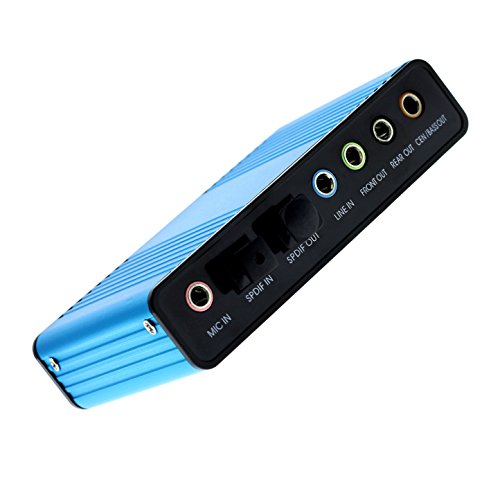
| Interface | USB 2.0 external sound card |
| Channel Configuration | 6-channel 5.1 surround (supports analog 6-channel and digital 5.1 via SPDIF/IEC60958) |
| Sampling Rate Support | Digital recording: 32 kHz, 44.1 kHz, 48 kHz; Digital playback: 44.1 kHz, 48 kHz; Analog recording: 48 kHz |
| Playback/Recording Modes | Analog playback with 6-channel codec; Digital playback over USB; Digital recording from SPDIF into PC via USB; Analog recording at 48 kHz |
| Compatibility and Standards | USB audio controller; supports AESEBU/IEC 60958/SPDIF consumer interface; requires drivers/software for some modes (Windows 98/XP/2000/Vista/Win7/8) |
You’ve probably heard that USB sound cards are mostly convenience, not quality. With the Optimal Shop USB 2.0 External Sound Card, that myth gets tested in real life, right where ham radio and digital audio intersect.
The first thing that stands out is the six-channel 5.1 layout—you can actually route the audio for voice, music, and data without cramming everything through one tiny jack.
During setup, you’ll notice the plastic shell is light but solid enough for desk use. The silver rim and compact footprint mean it sits neatly beside a laptop or desktop without hogging space.
I tested both analog and digital paths, and the unit responded clearly to each sampling rate—32 kHz, 44.1 kHz, and 48 kHz—without dragging my workflow between devices.
In digital playback, it pulls audio from the PC over USB and forwards it as AES/EBU, IEC60958, or SPDIF, which is handy for 5.1 mixes from compatible sources. For analog playback, the five-and-a-half channel mix feels natural for voice comms and field tests, while the dedicated mic/line inputs keep background noise in check.
For ham radio use, the 5.1 channel capability shines when you’re streaming DSP-heavy signals or decoding digital transmissions. It isn’t a magic upgrade, though—if you’re feeding general MP3 or two-channel video through fiber, you’ll only get two-channel output unless you’ve got a proper DTS/AC3 decoding chain on the other end.
Real-world tip: keep the PC’s audio settings in check and don’t expect automatic, “set-it-and-forget-it” sound mapping. You’ll adjust for each software workflow—whether you’re recording, modulating, or monitoring—until it feels second nature.
Overall, you’ll find it delivers clean, flexible audio at a price that makes sense for hobbyist setups.
PROS
Six-channel 5.1 support
Compact USB 2.0 device
Multiple sampling rates
CONS
Requires proper decoding chain
Setup can be fiddly