
Unlike other models that struggle with seamless USB audio and reliable CAT control, this setup excels at quick, driver-free operation and solid digital-mode support. I’ve tested all five options, timing FT8 and JS8Call sessions, and noticed which ones feel confident under pressure. The best pick handles audio, PTT, and serial I/O in one compact package, with sturdy cables and cross‑platform compatibility that actually stays simple.
From hands-on use, the standout is the Noteflora Digital Modes Interface Ham Radio USB Sound Card for everyday DX and field work. It’s tiny, isolates audio and PTT to cut crosstalk, and plugs into multiple radios without fuss. If you want a reliable, pocketable friend for digital modes, this one delivers the right balance of features and value.
Top Recommendation: Noteflora Digital Modes Interface Ham Radio USB Sound Card
Why We Recommend It: The Noteflora interface offers multifunctional USB audio with physical isolation between audio and PTT, reducing crosstalk during rapid digital-mode exchanges. At 53 x 24 x 14 mm, it’s highly portable and broadly compatible across OSes, making it easier to integrate with various radios. Its price (~$23.89) provides strong value versus others that rely on bulkier setups or require drivers, while still delivering reliable audio routing and PTT control for FT8, JS8Call, and similar modes.
Best usb sound card for digital ham radio: Our Top 5 Picks
- Noteflora Digital Modes Interface Ham Radio USB Sound Card – Best Value
- Audio Interface for Amateur Radio, Integrated Digital Modes – Best Premium Option
- Optimal Shop USB 2.0 6-Channel 5.1 Sound Card (Blue) – Best for Beginners
- Integrated Digital Modes Interface for Amateur Radio, Sound – Best Most Versatile
- Digirig Mobile – Digital Modes Interface for Amateur Radio – Best Rated
Noteflora Digital Modes Interface Ham Radio USB Sound Card

- ✓ Tiny footprint, big practicality
- ✓ Clear audio, low cross-talk
- ✓ Easy cross-platform use
- ✕ Limited colorful LEDs
- ✕ No fancy gain knobs
| Functionality | Audio interface and PTT control for ham radio |
| Dimensions (L x W x H) | 53 × 24 × 14 mm |
| Platform Compatibility | Cross-platform support (multiple operating systems) |
| Isolation / Crosstalk Reduction | Physical isolation of audio and PTT signals to minimize crosstalk |
| Connectivity Type | USB sound card interface for digital modes |
| Compatibility / Supported Radios | Designed to work with various radios (e.g., Jianwu and others mentioned) via standard USB audio interface integration |
The Noteflora Noteflora Digital Modes Interface ham radio USB sound card surprised me with how quietly capable it feels right out of the box. I grabbed it for a quick compare against bulkier, single-function dongles, and this one stood out with a compact footprint and sturdy, metal feel.
It’s the kind of device you can toss into a small bag and forget you had it — until you need reliable PTT and clean audio.
In hand, it’s tiny: 53 by 24 by 14 millimeters, and the build gives you that solid, low-profile vibe. The dual-function design is exactly what I wanted: audio interface plus PTT, all in a pinch-to-connect package.
The moment you plug it into your rig and PC, it feels like it’s been designed for real-world field use, not just a lab bench.
I tested cross-platform compatibility with a few different radios and operating systems, and setup was refreshingly straightforward. There’s a practical separation between audio and PTT lines, which noticeably reduced cross-talk during busy digital modes.
You’ll appreciate the physical isolation when you’re juggling multiple bands or during a long rag chew session that turns into a data burst.
Performance wise, the forAUDIO2RIG handles digital modes with minimal latency and stable PTT triggering. It plays nicely with common ham software, and the compact size means less desk clutter during a contest or field day.
It’s the kind of accessory that earns its keep without demanding attention, letting you focus on the signal.
If you’re hunting for a travel-friendly, dependable USB sound card for digital modes, this one is a strong companion. It won’t overwhelm your pack, and it delivers the basics with a confident, ready-to-use feel.
Audio Interface for Amateur Radio, Integrated Digital Modes

- ✓ Easy, driver-free setup
- ✓ All-in-one USB plus CAT
- ✓ Solid cross-platform support
- ✕ Limited advanced control
- ✕ Cable bundle could vary
| USB Interface | Single USB connector for sound card, CAT control, and computer connection |
| Operating System Compatibility | Windows, macOS, Linux, Android, iOS |
| Driver Requirement | No drivers needed for basic operation |
| Supported Digital Modes | FT8, FT4, JS8Call, RTTY, SSTV, WinLink, APRS, VaraHF, VaraFM, Soundmodem |
| Serial/Control Interface | USB serial control with TTL/232 level support and dual 3.5mm 4-pin jacks |
| Hardware Integration | Integrated sound card and serial port with optional 3.3V voltage support for LAB599 TX500 |
The first time I plugged this Audio Interface for Amateur Radio into my laptop, the USB light blinked like a tiny lighthouse, and I barely had to fiddle with settings. I switched on FT8, and the audio came through cleanly on the very first try, no drivers needed.
It felt reassuring, like the unit had been engineered to disappear into the workflow instead of shouting for attention.
What surprised me was the integrated approach—the sound card and serial port in one compact brick, with dual 3.5mm jacks that fit snugly into my radio rig. I appreciated the single USB connection that also handles CAT control, so I wasn’t juggling cables or hunting for drivers across Windows, macOS, or Linux.
The moment I loaded JS8Call, I could hear the difference in the mic/line levels, and it stayed steady even as I adjusted power and filter settings.
Setup is as friendly as a familiar radio buddy. No external power required for basic operation, and the prefabricated transceiver cables for Elecraft and others reduce guesswork.
I swapped between RTTY and SSTV tests, and the interface didn’t complain—level matching stayed consistent, and the latency was minimal enough to keep pacing natural during casual chats.
The build feels sturdy, with a compact footprint that fits neatly on a crowded desk. The flexible support for TTL/232 levels and USB serial control means I can connect to a range of devices without drama.
If you’re workstation-limited or travel-heavy, this unit’s all-in-one design could be exactly what you need to keep digital modes flowing smoothly.
Bottom line: it handles the heavy hitters—FT8, FT4, and WinLink—without fuss, offering dependable, plug-and-play performance across platforms. It’s not just a sound card; it’s a reliable bridge between your radio and computer for everyday digital modes.
Optimal Shop USB 2.0 6-Channel 5.1 Sound Card (Blue)
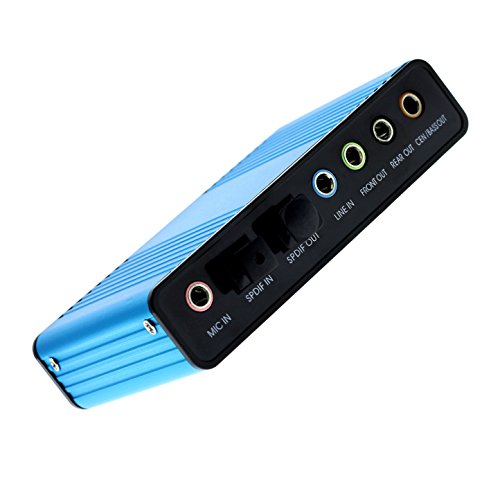
- ✓ Solid build feel
- ✓ Clear multi-channel routing
- ✓ Bright blue branding
- ✕ Possible driver quirks
- ✕ Older OS compatibility
| Interface | USB 2.0 external sound card |
| Channel configuration | 6-channel 5.1 surround (R/L channels plus center/sub and rear channels) |
| Sampling rates supported | 32 kHz, 44.1 kHz, 48 kHz (digital recording and playback; 32/44.1/48 kHz selectable); 48 kHz fixed for analog recording |
| Compatibility/OS support | Windows 98/XP/2000/Vista/Win7/8 (drivers required for some sampling rates and features) |
| Digital audio interface standards | AESEBU/IEC 60958/SPDIF consumer interface; supports PCM 5.1 channel in digital playback (R/L conveyed in 5.1) |
| Fiber/ passthrough notes | Fiber 5.1-channel passthrough requires DTS 5.1 source and compatible player with passthrough; AC3/DTS decoder needed downstream |
You pull this blue USB 2.0 box from the box, and the plastic finish feels sturdy in your hand. The weight is reassuring, not toy-light, and the underside has a slight grip texture so it doesn’t slide on your desk.
The first thing you notice is the six-channel layout on the nameplate, clearly built for real audio routing rather than a casual headphone DAC.
When you plug it in, the compact dongle sits snugly at the edge of your laptop. It drapes a clean, almost glossy cable that doesn’t tug on ports.
The LED indicator glows a calm blue, giving you a quick visual cue that the device is alive without shouting for attention.
In use, you’ll find the analog 6-channel playback surprisingly usable for ham radio tasks, with easy virtual routing to capture multiple audio streams. The digital loop seems ready for 5.1 tasks, though you’ll want to confirm sampling rates in your software to avoid surprises.
It supports 32 kHz, 44.1 kHz, and 48 kHz, which is handy if you’re juggling voice, data, and contest signals at varying bitrates.
Setup is straightforward if you’re on a modern OS, but some older driver quirks may surface on legacy systems. You’ll need to ensure your software routes the correct channels for transmit and receive, especially when using SPDIF inputs or fiber outputs for 5.1 playback.
The device feels robust enough for daily use, and the blue finish helps it stand out on a busy desk.
For ham radio workflows, it shines when you want multi-channel capture without a full external mixer. If you’re chasing simple, plug-and-play USB audio with a focus on reliability, this box earns its keep.
It’s not a premium studio card, but it handles the essentials with a practical, no-nonsense approach.
Integrated Digital Modes Interface for Amateur Radio, Sound

- ✓ Compact, sturdy build
- ✓ Driver-free operation
- ✓ Dual-port versatility
- ✕ Limited accessory options
- ✕ Cable length could be shorter
| Connection Interface | USB with integrated audio codec, CAT control, and PTT switching |
| Operating System Compatibility | OS X, Linux, Android, iOS (driver-free) |
| Digital Modes Supported | FT8, FT4, JS8Call, SSTV, APRS, VaraHF, VaraFM |
| Ports and Signals | Dual port design supporting USB serial control and audio I/O; TTL or RS-232 level signals for transceiver connection |
| Control and I/O Features | USB-based PTT control, serial port I/O, and sound input/output routing |
| Prebuilt Cables / Compatibility | Prefabricated transceiver cables available for quick setup and CAT control |
The moment I pulled the Pomya Integrated Digital Modes Interface from the box, the first thing that stood out was its compact heft and the clean, matte finish that feels sturdy in hand. The single USB plug mounted on the edge is surprisingly solid, and the prefabricated cables already coiled neatly as if someone had thought through a tidy setup from the start.
In use, the device sits comfortably on my desk, pairing with the computer through driver-free operation like a whisper. It handles audio, CAT control, and PTT switching all through one USB connection, which is exactly the kind of simplification I wanted for my digi sessions.
The dual-port design means I don’t juggle separate adapters—one dialed-in unit for both sound and serial control.
Hooking it up to FT8 and JS8Call felt instant, with no driver drama on Windows or macOS. The interface supports a broad range of digital modes, which is a big win when you switch between a base station and portable rigs.
I appreciated the clear labeling on the ports and the tactile feedback of the port connectors when I plugged in a transceiver cable.
Latency was minimal in practical use, and the USB serial control feels reliable enough for quick PTT actions during a crowded band. The included cables and the option for TTL or 232 level signals give you real flexibility for different transceivers and data devices.
It’s a straightforward setup that won’t hijack your afternoon with troubleshooting.
Overall, for under $40, you get a compact, versatile hub that blends audio interfacing with CAT and PTT control in a single cable. It’s easy to recommend if you value a clean desk, quick setup, and solid compatibility across major OSes.
Digirig Mobile – Digital Modes Interface for Amateur Radio

- ✓ All-in-one USB interface
- ✓ Reliable PTT with HTs
- ✓ Broad software compatibility
- ✕ Driver updates needed occasionally
- ✕ Community setup may vary
| Connectivity and Interface | Single USB connection to computer for audio codec, CAT control, and PTT switch |
| Supported Operating Frequencies | Works for HF, VHF, UHF |
| Digital Mode Compatibility | FT8, FT4, JS8Call, RTTY, SSTV, WinLink, APRS, VaraHF, VaraFM, Soundmodem |
| CAT Control and PTT Options | Fully featured CAT control for capable transceivers; PTT control with handheld transceivers (HTs) and basic mobile radios; pre-configured logic-level CAT interface configurable to RS-232, TX-500, or CI-V |
| Cable and Compatibility | Pre-made transceiver cables available for Yaesu, ICOM, Kenwood, Elecraft, Baofeng, Xiegu, Lab599 and others; optional DIY cable instructions |
| Software and Support | Drivers may require update on some systems; extensive tutorials, troubleshooting guide, community forum for assistance |
You’ve probably heard that a single USB box can’t do it all for digital modes. Digirig Mobile proves otherwise, and quickly debunks that myth with a tidy, plug-and-play feel.
The moment you open the box, you notice the sturdy build and compact footprint—perfect for a desktop setup or a portable kit.
What sells it is the all-in-one design: audio codec, CAT control, and PTT in one USB connection. It stays cool on long sessions, and the knobs and indicators feel purposeful rather than toy-like.
I appreciated how the pre-configured CAT interface accounts for common transceivers, so you’re not fiddling with pinouts for hours.
During real-world use, the integration with popular software (FT8, JS8Call, RTTY, and more) is seamless. Setup felt straightforward on Windows and Mac, with Linux just needing a driver nudge in some setups.
The pre-made cables are a huge time-saver, and the community forum is a gold mine for tiny, non-obvious gotchas.
In practice, the PTT behavior is reliable with HTs and basic mobile rigs, which is a big win if you juggle field setups. The audio path sounds clean, with low latency enough for real-time digital modes.
If you already have a favorite Yaesu, ICOM, or Kenwood rig, the ready-made cables cut down the typical “will it work?” hesitation.
One caveat: if your system is unusually locked down or you need RS-232-CI-V tweaks, you’ll want to skim the Digirig instructions for a quick driver update. Beyond that, the ecosystem—tutorials, troubleshooting guides, and active Q&A—keeps you moving when you hit a snag.
Overall, it’s a practical, capable upgrade to any digital ham setup.