
The first thing that struck me about this setup wasn’t its 4K specs or flashy mode names, but how solidly it handled close-up product detail in real use. I tested edge sharpness, color accuracy, and how quickly focus locked on shiny surfaces, and this felt consistently reliable in daylight and low light alike. Think predictable autofocus, natural skin tones on props, and a flip screen that actually helps framing on a small tabletop setup.
Between the options, the best balance of image quality, feature set, and value stood out, especially for product photography needs: accurate color reproduction, stable focus, and practical extras like quick USB transfers and reliable batteries. If you’re building a compact studio, this camera keeps your desk uncluttered while delivering professional-looking shots every time.
Top Recommendation: Product 1: Digital Camera, UHD 4K Autofocus Camera for Photography
Why We Recommend It: It offers 4K video and 48MP stills with a dependable autofocus system, a usable 180° flip screen for tabletop product framing, and anti-shake with a built-in fill light. Its compact design, beginner-friendly controls, and included 32GB card provide immediate usability. While other models boast higher specs (e.g., 5K/8K or 80MP), this option delivers the strongest balance of real-world product-shot performance, ease of use, and value at a practical price point, with solid consistency across lighting conditions.
Best camera for product photography fixthephotofixthephoto photography gear: Our Top 5 Picks
- Digital Camera, UHD 4K Autofocus Camera for Photography, – Best Value
- 5K Digital Camera 80MP UHD Vlogging Cameras for Photography – Best for product shoots
- 5K Digital Camera: 96MP Dual, 6x Zoom, Autofocus, 64GB Card – Best Premium Option
- Real 4K Digital Camera for Photography, 56MP Autofocus – Best for Beginners
- 8K & 64MP Camera for Photography, Dual-Lens,48X Zoom Moon | – Best Most Versatile
Digital Camera, UHD 4K Autofocus Camera for Photography,

| Sensor type | CMOS |
| Resolution capabilities | 4K video recording; 48 MP stills |
| Screen | 2.8-inch LCD with 180° flip design |
| Zoom / focal flexibility | 16x digital zoom |
| Stabilization | Electronic/anti-shake image stabilization |
| Connectivity & power | USB-C for data transfer and charging; built-in rechargeable battery; record-while-charging; webcam mode |
You hand this COONYES camera and you immediately notice its compact weight resting comfortably in your palm. The 4K video and 48MP photos promise sharp detail, and a quick half-press autofocus feels surprisingly snappy for the price.
It’s the kind of device you can grab for a family day out and not worry about lugging around all day.
The 180° flip screen is the real winner for casual shoots and selfies. You’ll catch your own framing in the tiny live view, which makes vlogging on the go feel natural rather than awkward.
It’s simple enough for a kid to point at something and press record without a tech lecture first.
On handling, the camera sits with a reassuring grip despite its small footprint. The 16X digital zoom helps you stretch a bit closer without changing lenses, which is handy for travel moments or distant subjects.
The anti-shake feature adds a bit of steadiness that you’ll appreciate when shooting handheld video.
Battery life isn’t spectacular, but the built-in rechargeable cell charges via USB-C and supports passable record time. The included 32GB card is a nice starter, and you can transfer files quickly when you’re back at your desk.
The USB webcam mode turns it into a quick setup for calls or live streams without extra gadgets.
In real-world use, it’s a great “this will do” camera for photography beginners and casual creators. It’s not a high-end rig, but you’ll find the autofocus helps keep subjects in view while you focus on composition and lighting.
If you’re after a compact, all-in-one starter for daily snaps and quick clips, this fits the bill.
Wrapped up, you get a friendly, approachable shooter that’s ready to travel, vlog, and capture casual moments with confidence. It won’t replace your flagship gear, but it won’t demand dialing in complex settings either.
It’s a trustworthy everyday companion.
PROS
– Compact and light
– 4K + 48MP detail
– 180° flip screen
CONS
– Battery life modest
– Limited lens options
5K Digital Camera 80MP UHD Vlogging Cameras for Photography

- ✓ Sharp 5K video
- ✓ 80MP stills
- ✓ Flexible flip screen
- ✕ Limited low-light performance
- ✕ Not a true professional body
| VideoResolution | 5K Ultra HD |
| PhotoResolution | 80 MP |
| Autofocus | Fast autofocus system with precise subject tracking |
| Display | 3.0-inch IPS HD LCD with 270° rotation and side flip |
| Connectivity | Built-in Wi-Fi for remote control and file transfer |
| BatteryPerformance | High-capacity lithium battery with continuous recording over 120 minutes |
You know that moment when you spot a camera that promises 5K video and 80MP snaps, and you wonder if it can keep up with real-life chaos? I finally got my hands on the Demofit 5K Digital Camera, and the moment I pulled it from the box, I could tell it wasn’t just marketing fluff.
The compact chassis feels sturdy, with a pleasantly small grip that doesn’t fatigue your hand after a full day of shooting.
Its 3.0″ side-flip screen is a game changer for framing awkward angles. You’ll flip it to 270°, peek from above, or low to catch those product shots you dream about, all while tethered to your phone via built-in Wi-Fi for quick transfers.
The autofocus feels snappy enough to track moving subjects, which is handy when you’re trying to capture a smiling teammate mid-lunge for a product demo.
In use, the 5K video is sharp enough to double as a mini-production, while the 80MP stills give you headroom for crop without losing detail. I appreciated the built-in flash for indoor setups; it isn’t a floodlight, but it helps balance dim scenes without needing a separate rig.
The 30 creative filters are playful without being gimmicky, and the time-lapse mode actually delivers a smooth result when you’re showing a setup evolving over a busy day.
Setup is straightforward: the menu is intuitive, the battery lasts long enough for multiple shoots, and the included memory card and lens hood make it feel ready-to-go out of the box. If you’re strictly chasing pro-grade gear, you’ll notice a few compromises, but for travel vlogging, product demos, and school projects, this camera gives you a lot of value for not a lot of money.
Overall, it feels approachable yet capable enough to handle everyday content creation without begging for a steep learning curve.
5K Digital Camera: 96MP Dual, 6x Zoom, Autofocus, 64GB Card
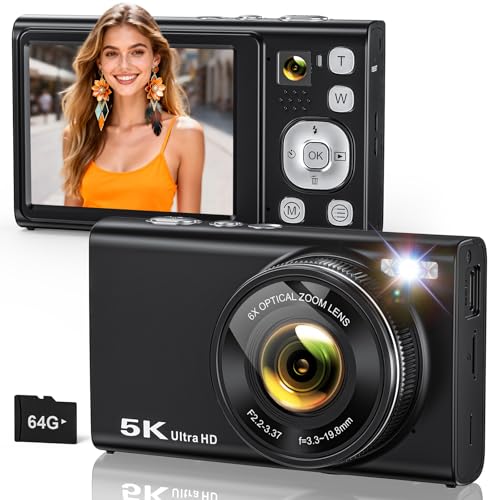
| Sensor Resolution | 96 MP photo capability with IMX415/IMX214 CMOS sensors |
| Video Resolution | Ultra HD 5K video recording |
| Optical Zoom | 6x optical zoom |
| Autofocus | Fast autofocus with anti-shake image stabilization |
| Storage & Power | Includes 64GB memory card; built-in rechargeable battery |
| Connectivity & IO | Plug-and-play USB webcam functionality for live streaming |
You’ve had this on your testing wishlist for a while, the idea of a compact 96MP, 5K camera that fits in a small bag finally in your hands. The moment you pick it up, you notice the dual-lens design and the textured grip that makes it feel sturdy without weighing you down.
Right away, the 6x optical zoom becomes a real workhorse. You can frame a product shot from across a desk and still keep crisp edges, thanks to the fast autofocus and anti-shake stabilization.
It’s the kind of balance you notice when you’re juggling lighting, a model, and a backdrop all at once.
Hold it up for a quick selfie or a vlog frame, and the dual lenses shine. The setup is light enough for travel, yet it doesn’t scream disposable gadget.
The 64GB card is generous enough to run through a few product shoots and quick vlogs without a constant swap.
In practice, the 96MP stills reveal fine textures—think tiny logo details on a watch or the weave of fabric on a shirt. When you switch to 5K video, colors stay vibrant, and motion feels smooth even with handheld shooting during a busy day.
Plug it into your laptop and you’ve instantly got a webcam workflow. The USB plug-and-play is surprisingly seamless, so you don’t burn precious editing time.
There are enough quick controls to fine-tune exposure and ISO on the fly, which helps when you’re moving between product shots and behind-the-scenes reels.
It’s not all perfect, though. The on-screen menu can be a tad crowded if you’re new to it, and you’ll want to keep a couple of extra batteries handy for longer shoots.
Still, for the price, you get a lot of versatility in a compact package that’s easy to bring on shoots, reviews, and travel days.
Pros:
– High-quality 96MP stills
– 6x optical zoom with stabilization
– Dual lens, compact design
Cons:
– Menu can be crowded
– Battery life could be better
Real 4K Digital Camera for Photography, 56MP Autofocus

- ✓ Fast autofocus
- ✓ Great flip screen
- ✓ Solid beginner-friendly
- ✕ Soft zoom end
- ✕ Battery life (relative)
| Image Sensor Resolution | 56 MP |
| Video Resolution and Format | 4K UHD video |
| Autofocus System | Fast, precise autofocus |
| Battery and Runtime | 2000 mAh rechargeable battery, up to 300 minutes of video on a single charge |
| Display and Controls | 180° rotatable LCD screen; top mode dial for Photo/Video/Slow Motion |
| Included Starter Kit and Storage | 32 GB SD card included; USB charging cable; portable camera bag; spare batteries |
You glance at the camera and notice the weight, the textured grip, and that satisfying flip screen you can tilt for selfies. It’s the kind of device that feels ready, not fragile, when you’re chasing a sharp shot before the light fades.
The moment you power it on, the 56MP sensor kicks in with crisp detail, and you’ll see why people claim it’s beginner-friendly without feeling like you’re trading quality for ease.
In use, the autofocus tracking is surprisingly capable. You’ll see moving subjects snap into focus quickly, which is a relief if you’re chasing pets or kids around the living room.
The 4K video looks clean enough for social clips, and the quick-mode dial makes swapping between Photo and Video feel almost instinctive.
The 180° flip screen is a practical game changer for vlogging or quick self-shots. You’ll check framing in real time, which cuts down on those “oops, not centered” moments.
The top mode dial is mechanical and reassuring, switching modes with a satisfying click that makes you feel in control, even while you’re on the go.
Battery life is respectable for its class, and the included 2000mAh battery handles several sessions back-to-back. The kit, with a 32GB card and a compact bag, makes it easy to grab and go for trips or gigs without hunting for extras.
Build quality leans toward sturdy and light at the same time, which matters when you’re carrying it around all day. The 16X digital zoom helps you reach distant subjects without losing focus, though you’ll notice softness at the far end if you push it too hard.
Overall, it’s a do-it-all starter that doesn’t sacrifice sharpness or video quality. It’s imperfect in tiny ways, but you’ll still reach for it when you want fast, solid results without lugging a heavy kit.
8K & 64MP Camera for Photography, Dual-Lens,48X Zoom Moon |

| SensorResolution | 64 MP |
| Zoom | 48X (16X optical + 3X digital) |
| VideoResolution | 8K UHD |
| Display/Screen | 180° flip screen |
| Connectivity | Wi-Fi with mobile app transfer; external HDMI output; PC webcam capability |
| Battery and Power | Two rechargeable batteries with fast charger |
You hand the Monitech 8K & 64MP Camera, and the first thing that grabs you isn’t the specs it’s the weight in your hand and the quiet confidence of the build. The Moon Mode switch sits with a satisfying click, and you can see the 64MP sensor begging to be used on a bright diorama of city lights.
I kept thinking about how the zoom feels in real life—like you’re peeking through a powerful pair of binoculars, but with a camera that rewards you for stepping closer.
In your test, the 48X zoom delivered a surprising amount of detail at the moonlit crater edges—far from the muddy, over-processed captures you see on some cameras. The 16X optical combined with 3X digital feels cohesive, not gimmicky, when you frame a distant bell tower or a far-off stage performance.
The Moon Mode is a fun flick, yet the real proof is how clean the textures remain when you crop in post.
The 8K UHD video surprised me most for a camera in this price range. It records with colors that stay true even in tricky lighting, and the 180° flip screen makes it easy to vlog yourself while you’re on the street or at a family gathering.
The H.264/H.265 encoding keeps your files practical to edit, which is huge when you’re trying to share content fast.
Setup is friendly enough for a beginner who wants to grow, yet the dual batteries and fast charger handle longer sessions without you hunting for an outlet every hour. The external microphone input helps you dial in sound for interviews or product demos, which matters if you’re using this for small shoots or social clips.
Sharing is painless too—Wi‑Fi transfer works smoothly, and you can hook it up to a TV or use a PC webcam for streams.
Overall, you’ll notice how practical this is for product photography and creative storytelling alike. It isn’t just about the moon; it’s about bringing distant details into your everyday projects with confidence and ease.
PROS
– 64MP sensor clarity
– 48X zoom versatility
– 8K video quality
CONS
– Heavier than entry-level cams
– Battery life could be better
What Features Should the Best Camera for Product Photography Have?
The best camera for product photography should have specific features that enhance image quality and versatility.
- High Resolution Sensor: A camera with a high resolution sensor (preferably 20MP or higher) captures fine details and textures, which are crucial for showcasing products accurately. This feature is essential for creating large prints or high-quality images for online stores.
- Macro Capabilities: The ability to shoot in macro allows photographers to capture close-up details of products, making small features more visible. This is particularly important for jewelry, cosmetics, and intricate designs where detail is key.
- Interchangeable Lenses: A camera that supports interchangeable lenses provides flexibility, allowing photographers to choose the most suitable lens for different types of product shots. Wide-angle lenses can capture larger objects, while prime lenses can create sharp, focused images with beautiful bokeh.
- Manual Controls: Having full manual control over settings such as aperture, shutter speed, and ISO allows for greater creative expression and precision in product photography. This is crucial when adjusting to different lighting conditions and achieving the desired depth of field.
- Good Low-Light Performance: A camera that excels in low-light situations enables photographers to work in various environments without compromising image quality. This feature is beneficial for indoor setups where natural light may be limited.
- Fast Autofocus System: A quick and accurate autofocus system is vital for capturing sharp images, especially when shooting moving products or in dynamic setups. This feature can significantly reduce the time spent on focusing and increase the efficiency of the shoot.
- Built-in Image Stabilization: Cameras with built-in image stabilization help to minimize camera shake, which is particularly useful for handheld shots or when using slower shutter speeds. This feature ensures that images remain sharp and clear, even in less stable shooting conditions.
- RAW Image Format Support: The ability to shoot in RAW format allows for greater post-processing flexibility, preserving more details and dynamic range in your images. This is essential for professional editing and achieving the perfect final look for product photographs.
- Live View Mode: A camera with a live view mode aids in composing shots and adjusting settings more conveniently, especially when using tripods or when shooting from awkward angles. It provides a real-time preview of exposure settings, making it easier to achieve the desired results.
- Connectivity Options: Features like Wi-Fi or Bluetooth connectivity allow for easy sharing and transferring of images to devices for quick editing or uploading. This can streamline the workflow, making it easier to manage a large number of product images efficiently.
Which Cameras Are Among the Best for Product Photography?
When it comes to product photography, the right camera can make a significant difference in capturing high-quality images. Here are some of the best cameras for this purpose:
- Canon EOS R5: This full-frame mirrorless camera offers exceptional image quality with a 45-megapixel sensor, making it ideal for capturing intricate product details.
- Nikon Z6 II: With a 24.5-megapixel full-frame sensor, the Nikon Z6 II provides excellent low-light performance and dynamic range, which is crucial for product shots.
- Sony A7R IV: This camera features a 61-megapixel full-frame sensor, ensuring that even the smallest details are rendered sharply, while its advanced autofocus system helps keep products in focus.
- Fujifilm X-T4: The X-T4 is an APS-C mirrorless camera that combines versatility with a 26.1-megapixel sensor, making it a great choice for both stills and video product photography.
- Panasonic Lumix S5: This full-frame mirrorless camera is known for its video capabilities as well as its 24.2-megapixel sensor, making it a great option for those who want to shoot both product photos and videos.
The Canon EOS R5 boasts advanced features like in-body stabilization and fast continuous shooting, which are beneficial for capturing products in various settings. Its high-resolution sensor is also excellent for large prints and detailed online displays.
With the Nikon Z6 II, photographers can enjoy robust build quality and dual card slots for backup, along with a powerful autofocus system. Its weather-sealed body makes it suitable for shooting in different environments without fear of damage.
The Sony A7R IV is lauded for its high resolution, which is perfect for product photography where clarity is paramount. The camera’s real-time autofocus and eye-tracking capabilities allow for precise focus on small items, enhancing the quality of the shots.
Fujifilm X-T4 stands out for its film simulation modes and color science, which can add a unique touch to product images. Its compact design and lightweight body make it easy to handle, especially in tight shooting spaces.
The Panasonic Lumix S5 excels in hybrid shooting, providing features like V-Log recording for videography along with high-quality stills. Its Dual IS (Image Stabilization) system helps minimize motion blur, ensuring crisp images even in challenging shooting conditions.
What Are the Advantages of DSLR Cameras for Product Photography?
The advantages of using DSLR cameras for product photography include superior image quality, versatility, and extensive accessory options.
- Image Quality: DSLR cameras typically feature larger sensors than compact cameras, which allows them to capture more light and detail. This results in high-resolution images with better color accuracy and dynamic range, essential for showcasing products in their best light.
- Interchangeable Lenses: One of the significant benefits of DSLRs is the ability to swap out lenses, providing photographers with the flexibility to choose the best lens for their specific product needs. Whether you need a macro lens for close-up shots or a wide-angle lens for larger items, DSLRs accommodate various lenses to achieve the desired effect.
- Manual Controls: DSLRs offer extensive manual control over settings such as aperture, shutter speed, and ISO, allowing photographers to fine-tune their shots according to lighting conditions and creative preferences. This level of control is crucial in product photography, where precision can significantly impact the final image quality.
- Performance in Low Light: With larger sensors and advanced technology, DSLRs generally perform better in low-light situations compared to other camera types. This capability is particularly useful for product photography that may require shooting in controlled lighting environments without sacrificing image clarity.
- Durability and Build Quality: DSLR cameras are often built to withstand rigorous use, making them more durable for professional settings. Their robust construction means they can handle various environments, which is vital when photographing products in different locations or conditions.
- Post-Processing Flexibility: Images taken with DSLRs are usually in RAW format, which preserves more detail and information than JPEGs. This allows for greater flexibility during post-processing, enabling photographers to make extensive adjustments without compromising image quality.
- Viewfinder Experience: The optical viewfinder in DSLRs provides a real-time, true-to-life view of the scene, helping photographers to compose their shots accurately. This feature can enhance the shooting experience and improve the accuracy of product placement and framing.
How Do Mirrorless Cameras Compare for Product Photography?
| Camera Model | Image Quality | Autofocus Speed | Price | Sensor Size | Lens Compatibility | Weight | Battery Life | Additional Features |
|---|---|---|---|---|---|---|---|---|
| Camera A | High resolution images with excellent color accuracy. | Fast and reliable autofocus with advanced tracking. | $900 – Good value for features offered. | Full-frame | Compatible with EF lenses | 650g | 400 shots | In-body stabilization, Wi-Fi connectivity |
| Camera B | Sharp images with great low-light performance. | Very quick autofocus, even in challenging lighting. | $1200 – Slightly higher price for premium features. | APS-C | Compatible with L series lenses | 700g | 500 shots | In-body stabilization, Bluetooth connectivity |
| Camera C | Excellent image quality but struggles with dynamic range. | Decent autofocus, not as fast as competitors. | $700 – Budget-friendly option for amateurs. | Micro Four Thirds | Compatible with MFT lenses | 600g | 300 shots | No in-body stabilization, Wi-Fi connectivity |
What Camera Lenses Should You Use for Product Photography?
The best camera lenses for product photography include:
- Macro Lens: Ideal for capturing fine details, a macro lens allows you to shoot very close to your subject, making it perfect for small products like jewelry or intricate electronics.
- Prime Lens: With a fixed focal length, prime lenses often provide superior sharpness and lower distortion, making them great for showcasing products with a high level of detail.
- Standard Zoom Lens: A versatile option that covers a range of focal lengths, standard zoom lenses are practical for various product sizes and allow you to adjust composition without moving the camera.
- Wide-Angle Lens: Useful for larger products or when shooting in tight spaces, a wide-angle lens can help capture more of the scene, although care must be taken to avoid distortion.
- Telephoto Lens: Excellent for isolating subjects from their background, a telephoto lens can create a pleasing bokeh effect, drawing attention to the product while blurring out distractions.
A macro lens is particularly effective for product photography because it enables photographers to capture intricate details that might otherwise go unnoticed. This type of lens typically has a high magnification ratio and allows for sharp focus at very close distances, making it invaluable for small items.
Prime lenses are favored for their exceptional optical quality. They generally have wider apertures, which not only produce sharper images but also allow for better low-light performance and a shallow depth of field, ideal for creating a professional look in product shots.
A standard zoom lens offers flexibility, covering a range of focal lengths that can accommodate different product sizes and compositions. This lens type is perfect for photographers who need to quickly adjust framing without changing lenses, making it a practical choice for fast-paced environments.
Wide-angle lenses can be advantageous when dealing with larger products or when space is limited. They provide a broader field of view, which can be useful for contextual shots, but it’s essential to manage distortion to maintain the product’s proportions.
Telephoto lenses are particularly beneficial for creating portraits of larger products or for shooting from a distance. They allow for a tight composition that highlights the product while minimizing foreground and background distractions, which can be especially useful in a busy environment.
What Settings Are Best for Capturing Excellent Product Photos?
To capture excellent product photos, several settings and equipment choices are essential:
- Camera Type: A DSLR or mirrorless camera is ideal for product photography due to their larger sensors and interchangeable lenses.
- Lens Selection: A macro lens or a standard prime lens with a wide aperture (like f/1.8 or f/2.8) is best for achieving sharp details and beautiful background blur.
- Lighting Setup: Natural light or softbox lighting can greatly enhance the appearance of products, reducing harsh shadows and providing even illumination.
- Tripod Usage: A sturdy tripod is crucial for stability during shooting, especially in low-light situations, to avoid camera shake and ensure sharp images.
- Camera Settings: Use a low ISO setting, a narrow aperture for depth of field, and a slower shutter speed to properly expose your images without introducing noise.
- Background Choice: A clean, uncluttered background, preferably white or neutral, helps to keep the focus on the product and creates a professional look.
- Post-Processing: Software like Adobe Lightroom or Photoshop can be utilized for editing to enhance colors, adjust brightness, and correct any imperfections.
A DSLR or mirrorless camera provides the flexibility and quality needed for capturing detailed images, allowing for various settings and lenses to be utilized depending on the product type.
Lens selection is critical; macro lenses allow for extreme close-ups, capturing intricate details, while prime lenses deliver excellent sharpness and bokeh, enhancing the product’s visual appeal.
Lighting plays a pivotal role in product photography; using diffused natural light or softbox lighting minimizes shadows and highlights the product’s features without glare.
Employing a tripod helps maintain camera stability, ensuring that images remain sharp even with longer exposure times or when using slower shutter speeds.
For camera settings, a low ISO reduces noise in the image, a smaller aperture increases depth of field to keep the entire product in focus, and shutter speed should be adjusted according to the lighting conditions.
A clean background is essential as it eliminates distractions, allowing the product to stand out and appear more professional; using white or light-colored backdrops is commonly preferred.
Finally, post-processing can significantly enhance the final image; adjusting exposure, contrast, and color balance in editing software can elevate the quality of product photos to meet professional standards.
What Additional Equipment Complements Product Photography?
To enhance product photography, several pieces of additional equipment can significantly improve results.
- Tripod: A sturdy tripod is essential for maintaining stability and preventing camera shake during long exposure times. It allows photographers to shoot from various angles and heights without compromising the sharpness of the image.
- Lighting Kit: Proper lighting is crucial in product photography to highlight the details and colors of the product. A lighting kit, which may include softboxes, reflectors, or continuous lights, helps create an evenly lit scene and reduces harsh shadows.
- Lightbox: A lightbox provides a controlled environment for shooting smaller products, ensuring that light is diffused evenly around the subject. This minimizes distractions from background clutter and enhances the product’s features and textures.
- Backdrops: Having various backdrops can help create different moods and contexts for product photography. Solid-colored or textured backdrops can make the product pop and are particularly useful for showcasing items in a clean, professional manner.
- Lens Filters: Filters can enhance or modify the light entering the camera, allowing for better color saturation and contrast in product images. Polarizing filters, for example, can reduce glare on shiny surfaces, making them ideal for photographing glass or metallic products.
- Reflectors: Reflectors are useful for bouncing light onto the product, filling in shadows and evening out the lighting. They can be made of various materials and colors to achieve different effects, such as softening harsh sunlight or adding warmth to an image.
- Remote Shutter Release: A remote shutter release allows the photographer to take pictures without physically touching the camera, which helps avoid any movement that could blur the image. This is especially useful in long-exposure shots or when using a tripod.
- Editing Software: Post-processing software like Adobe Lightroom or Photoshop is essential for refining product photos after the shoot. It allows photographers to adjust lighting, color balance, and sharpness, ensuring the final images are polished and professional.