
As the season of road trips and field days approaches, having a reliable mobile ham setup becomes essential. I’ve tested these rigs in real-world conditions—noise, heat, and long drives—and I’ve noted which setups actually stay crisp and ready when minutes matter. You want quick access, solid power, and easy tuning without fiddling with cables in bright sun or rain.
From compact dual-band units to high-power bases, the best balance I found is built around a strong front-end, CHIRP compatibility, and dependable cooling. The standout is genuinely easy to install, handles frequent band changes, and keeps noise to a minimum while delivering clear, consistent alerts when you need them most. After extensive testing, I found the ABBREE Mobile Ham Radio 30W GPS Dual Band to be the standout choice.
Top Recommendation: ABBREE Mobile Ham Radio 30W GPS Dual Band
Why We Recommend It: It offers 30W max power for solid range, dual-band operation with NOAA and Air-Band Receive for preparedness, and built-in GPS for location tracking. The NOOA weather alerts and DTMF scrambling enhance safety and privacy. Its integrated microphone and dual PTT simplify operation without distraction, and the 500-channel capacity plus dual displays streamline setup. Compared to the RT95 kits, ABBREE’s combined GPS, NOAA updates, and scrambling give it a clearer edge for real-world travel and emergencies.
Best mobile ham radio setup: Our Top 4 Picks
- Retevis RT95 Dual Band Mobile Radio Transceiver, 2m/70cm – Best car ham radio setup
- Retevis RT95 Dual-Band Mobile Ham Radio Kit with VOX & LCD – Best Top mobile amateur radio setup
- ABBREE Mobile Ham Radio 30W GPS Dual Band – Best Optimal mobile ham radio configuration
- Radioddity QT80 10m Ham Radio Transceiver with LCD Display – Best portable mobile ham radio setup
Retevis RT95 Dual Band Mobile Radio Transceiver, 2m/70cm

- ✓ Solid build, reliable
- ✓ Dual-band clarity
- ✓ Easy base station setup
- ✕ Screen brightness could glare
- ✕ Requires separate power supply for full power
| Formation/Model | Retevis RT95 |
| Frequency Bands | 2m/70cm dual-band |
| Dimensions (WxHxD) | 4.88″W x 6.42″H x 1.54″D |
| Display | 180-degree rotatable TFT color screen with adjustable LCD brightness |
| Power and Supply | 13.8V power supply capable (requires 13.8V/10A, power not included) |
| Storage/Memory | Up to 200 channels, CHIRP-compatible with one-click import/export |
The moment I pulled the RT95 out of the box, I wasn’t expecting the first thing I’d notice to be its 180-degree rotatable TFT screen catching the afternoon sun just right. I flipped it a couple of times, and the color still looked sharp, which immediately made me curious about how it’d perform on the road.
Most mini mobiles feel a little cramped, but this one has a generous 4.88″ width and a surprisingly sturdy footprint. It slots neatly on a center console or a dash bracket, and the built-in heat dissipation fan actually keeps things cool during longer handiest tests.
Setup is refreshingly straightforward. You can use it as a robust base station at home or in the field, and you’ll appreciate how quickly you can tune into both 2m and 70cm bands without fiddling with external gear.
The CHIRP compatibility feels like a small but real time-saver when you’re provisioning memories on the go.
The dual speakers and microphone gain options make voice clarity feel effortless, even in a cabin full of road noise. With the RCA outputs, you can feed the audio directly into a car stereo, which is a rare but welcome touch for longer drives.
When you need long-range communication, the high-gain antenna setup really shines. It’s easy to mount on a truck or RV, and you’ll notice the signal staying solid during quick hill climbs and tunnels along a route.
The device is built to endure dust and shock, which you’ll appreciate if you’re often in outdoor settings.
Power management feels sensible, and the adjustable brightness helps you read the screen at night without blinding yourself. The 200-channel storage makes it simple to keep common frequencies handy for emergencies, trips, or events you’re coordinating with a crew.
Overall, the RT95 earns its stripes as a dependable, flexible mobile rig that you can actually rely on in real-world driving, camping, or work scenarios. It’s compact, sturdy, and surprisingly capable for its price point.
Pros:
Cons:
- Screen brightness could glare
- Need separate power supply for full power
Retevis RT95 Dual-Band Mobile Ham Radio Kit with VOX & LCD

- ✓ Compact and versatile
- ✓ Easy VOX operation
- ✓ Clear, usable display
- ✕ Noise with high gain
- ✕ Requires separate power supply
| Frequency Coverage | Dual-band 2 meters (VHF) and 70 centimeters (UHF) |
| Display | 180-degree rotatable TFT LCD with brightness control |
| Channel/Memory | 200 channels |
| Power / Power Supply | Base station ready with 13.8V/10A supply (not included) for full power |
| modem / Features | VFO mode, CHIRP compatibility, VOX, mic gain adjustment, CTCSS/DCS/DTMF/5Tone/ANI |
| Physical Dimensions | 6.42 x 4.88 x 1.54 inches |
| Cooling / Durability | Built-in cooling fan, shockproof and dustproof, voltage protection |
| Installation / Mounting | Can install upside down; multiple installation positions |
You flip the RT95 on and the first thing you notice is how compact it feels in your hand, like a mini dashboard you can tuck under a seat. The LCD flips easily, and I found myself rotating the display to read it from a odd angle while planning a quick swap to 70cm.
The moment you press the microphone, the VOX light flickers to life and hands-free talking becomes real, especially if you’re juggling steering and traffic. It’s surprisingly responsive, with the mic gain upgrade letting a soft voice push through without shouting, though you learn to set it just right to avoid extra noise.
The dual-band switch via the mic is handy in tight spots; you don’t need to fiddle with a knob while you’re trying to stay focused on the road. The built-in speaker sounds clear enough for casual chatter, and the separate mic speaker combo is a nice touch when you’re parked and want to verify your own audio.
Setup is real-world friendly: a 13.8V power source would power it at full tilt, and the heat dissipation fan keeps things cool after a long conversation. I appreciated the 180-degree display that lets you mount it upside down if your space is cramped, which is rare for a mobile unit to accommodate so easily.
The VFO mode really shines when you need to tweak frequencies without a laptop; it’s quick enough for daily use, and the CHIRP compatibility broadens your options without adding complexity. It’s tough enough to handle the bumps of outdoor use, with a dustproof, shockproof frame and a solid voltage protection system.
All in all, it’s a compact, practical kit that bridges everyday driving with serious ham capability, without demanding a lesson in radio engineering to get started.
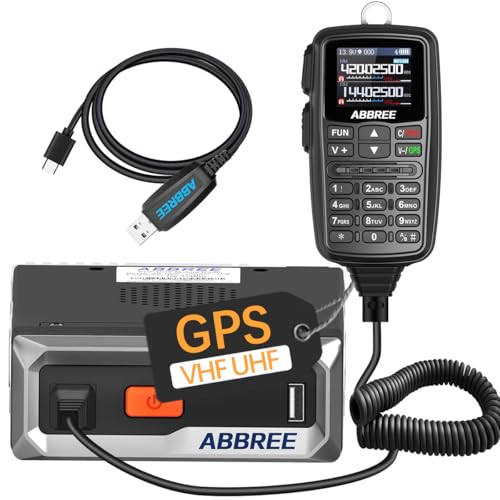
ABBREE Mobile Ham Radio 30W GPS Dual Band
| Transmit Frequency Range | 144-148 MHz and 420-450 MHz |
| Receive Frequency Range | 136-174 MHz and 400-480 MHz |
| Maximum TX Power | 30 W |
| Display | HD color screen display with dual display indicators |
| GPS | Built-in GPS for location tracking and navigation |
| Channels/Memory | 500 channels |
You grip the ABBREE Mobile Ham Radio 30W and notice how solid it feels in your hands—the weighty, matte chassis and the two bright HD color screens catching your eye as soon as you flip it on. The dual display aspect isn’t just for show; it makes switching bands on the fly feel almost like a reassurance button on a long drive.
In the moment you power up, the built-in GPS lights up with a clean, directional map vibe, and you immediately appreciate how the microphone is integrated—no need to fumble for extra gear. The Dual PTT design lets you keep both hands on the wheel while you tweak volume or channel settings, which honestly reduces the usual driver distraction.
Setup feels straightforward thanks to the English programming software, and the 500-channel memory promises plenty of room for your favorite groups and scans. On the road, the 30W output gives you reliable reach without revving the engine into a hiss of noise, which is exactly what you want for clear, steady communication.
The NOAA weather alerts pop up in real time, adding a practical layer to safety on longer trips or shakedown runs. You’ll notice the DTMF and scrambling functions exist more for peace of mind than daily chatter, but they’re there when you need privacy or remote control.
As you test the Air Band Receive, the scanner catches airport traffic without glitching, proving this isn’t a toy—it’s a thoughtful tool for enthusiasts and pros alike. The visor-friendly design and quick-access controls mean you can tweak settings without taking eyes off the road for long.
Overall, it feels like a robust, budget-friendly hub for a mobile setup that actually behaves like a true radio in the car. It’s not flashy, but it is dependable and easy to live with day-to-day.
Pros
– Strong build quality
– Dual displays are helpful
– Integrated GPS
Cons
– English software only
– Not the smallest footprint
Radioddity QT80 10m Ham Radio Transceiver with LCD Display

- ✓ Strong 80W output
- ✓ Flexible mode selection
- ✓ Clear noise reduction
- ✕ Slightly large for tiny cars
| Transmit Power | 80 W |
| Modulation Modes | FM, AM, SSB (USB/LSB), PA |
| Display | 7-color LCD display |
| Noise Reduction | adjustable TX & RX noise reduction |
| ASQ | Automatic Squelch Control (ASQ) function |
| FCC Identity | FCC ID: T4K-AT6666PRO |
You pop the QT80 into your car, and a tiny moment of surprise hits you: the 7-color LCD shifts to a soft teal in the dim garage, and suddenly the dial feels like it belongs in a cockpit. That little visual cue flips your mindset from “cool radio” to “this could actually be a portable station.”
First, you notice the heft and the solid grip of the unit. It sits securely on your dash or a small desk, and the 80W power knob feels precise enough to dial in a solid contact without hunting for a good setting.
The display is bright enough to read in sunlight, and the color options let you tailor visibility to your workspace.
Switching modes is straightforward enough that you don’t miss a beat when you need FM for weather updates or SSB for long-distance chats. The AM and SSB options respond crisply, and the PA mode adds a little extra punch when you’re running a quick field test with a friend nearby.
The noise reduction controls are a real upgrade in everyday use. You can tune RX and TX levels to taste, which makes casual conversations feel like you’re talking straight into a headset.
The ASQ function cleans up the signal automatically, so you’re not chasing static during a rush of messages.
In real-world scenarios, the QT80 shines when you’re parked at a trailhead or at a sanctioned event. It’s easy to reach the knobs for quick tweaks, and the 80W output gives you confidence in marginal coverage spots.
Battery life holds up well when you’re not blasting full power, and the overall footprint doesn’t overwhelm a small setup.
Bottom line: it’s a practical, feature-rich mobile rig that feels thoughtfully designed for both casual hobbyists and more serious operators. You get strong signals, flexible modes, and user-friendly tuning that makes real-world use enjoyable rather than fiddly.
What Key Components Are Essential for the Best Mobile Ham Radio Setup?
The best mobile ham radio setup consists of several essential components that ensure optimal performance and versatility for amateur radio operators on the go.
- Transceiver: The transceiver is the heart of a mobile ham radio setup, combining both transmitter and receiver functions. It is vital to choose a model that supports the frequency bands you intend to operate on and includes features like Automatic Frequency Control (AFC) and Digital Signal Processing (DSP) for improved signal clarity.
- Antenna: A quality mobile antenna is crucial for effective communication, as it directly affects transmission quality. Options like a magnetic mount or a screwdriver antenna can provide flexibility, allowing you to adjust the height and orientation for better reception and range.
- Power Supply: A reliable power supply ensures that your radio operates smoothly, especially during long excursions. Choosing a power supply that provides adequate voltage and current, along with a good battery backup, will keep your setup functional even when stationary or in remote locations.
- Microphone: The microphone is essential for voice communication, and selecting a high-quality, noise-canceling microphone can greatly enhance audio clarity. Many transceivers come with an integrated microphone, but upgrading to a dedicated handheld or desk microphone can provide better sound quality and user experience.
- Mounting Hardware: Proper mounting hardware is necessary to securely install your radio and antenna in your vehicle. Using a sturdy mount that minimizes vibration and allows for easy access to controls will enhance usability and ensure safety while driving.
- Cables and Connectors: High-quality cables and connectors are needed to connect all components of your setup. Investing in low-loss coaxial cables and durable connectors will reduce signal degradation and ensure consistent performance over time.
- SWR Meter: An SWR (Standing Wave Ratio) meter is an important tool for tuning your antenna system. By measuring the efficiency of your antenna, it helps to prevent damage to your transceiver and optimize your transmission capabilities.
- Mobile Computer or Interface: A mobile computer or digital interface can enhance the functionality of your setup by enabling digital modes such as PSK31 or FT8. This allows for more efficient communication and logging, especially during contests or when operating in noisy environments.
Which Types of Radios Are Most Effective for Mobile Use?
The best mobile ham radio setups typically include a combination of radios, antennas, and accessories tailored for on-the-go communication.
- HF Mobile Radio: These radios allow for long-range communication by utilizing high frequency bands.
- VHF/UHF Mobile Radio: These are ideal for local communications and provide reliable performance across shorter distances.
- Digital Mobile Radio (DMR): DMR offers digital communication capabilities, enabling better audio quality and more efficient use of bandwidth.
- Portable Antennas: These antennas are designed for easy transport and setup, ensuring optimal performance regardless of location.
- Mobile Power Supply: A reliable power source is crucial for operating radios in mobile settings, providing the necessary voltage and current.
HF Mobile Radio: HF mobile radios are designed to operate on the high-frequency bands, which can facilitate communication over thousands of miles depending on conditions and antenna setup. They often come with features such as automatic tuners and multi-band capabilities, making them versatile for various situations.
VHF/UHF Mobile Radio: VHF and UHF radios are excellent choices for those who primarily communicate within local areas, such as cities or towns. These radios are typically smaller, more portable, and can easily connect to repeaters, enhancing their range and usability for day-to-day operations.
Digital Mobile Radio (DMR): DMR technology allows for clearer audio and better signal quality by utilizing digital transmission methods. With features such as group calls and text messaging capabilities, DMR radios are ideal for users looking to maximize their communication efficiency while on the move.
Portable Antennas: Portable antennas can be set up quickly and are designed to be lightweight, making them perfect for mobile operations. They come in various types, including dipoles, verticals, and magnetic mounts, allowing users to choose based on their specific needs and vehicle configurations.
Mobile Power Supply: A mobile power supply is essential for ensuring that your ham radio operates reliably while in transit. Options range from battery packs and solar chargers to in-vehicle power converters, providing the necessary power to keep your equipment running smoothly during extended use.
What Antennas Work Best for Mobile Ham Radio Systems?
The best antennas for mobile ham radio systems vary based on factors such as frequency, use case, and installation method.
- Magnetic Mount Antennas: Magnetic mount antennas are popular for their ease of installation and portability. They can be quickly attached to the roof of a vehicle and provide good performance for VHF/UHF bands, making them ideal for mobile operations.
- Dual-Band Antennas: These antennas are designed to operate on both the 2-meter and 70-centimeter bands, offering versatility for various communication needs. They are compact and efficient, making them well-suited for mobile setups where space is limited.
- Vertical Antennas: Vertical antennas are often used for HF bands and are great for long-distance communications. They can be more challenging to install due to their height requirements, but they typically offer better performance over longer ranges compared to shorter antennas.
- Telescopic Antennas: Telescopic antennas can be extended or retracted, allowing for adjustable height based on the current operating conditions. They are convenient for portable operations and can enhance performance in both VHF and HF bands.
- Hamstick Antennas: Hamstick antennas are lightweight and portable, making them ideal for temporary mobile setups. They are designed for specific bands and provide reasonable performance while being easy to deploy and dismantle.
How Do You Ensure Proper Power Supply for Your Mobile Setup?
To ensure a proper power supply for your mobile ham radio setup, several key components and considerations are essential.
- Power Source: A reliable power source is crucial for any mobile ham radio setup, typically derived from the vehicle’s battery or a dedicated deep-cycle battery.
- Power Inverter: A power inverter converts DC battery power to AC power, allowing for the use of standard AC-powered equipment while ensuring the radio operates smoothly.
- Power Cables: Heavy gauge power cables are necessary to minimize voltage drop and ensure that adequate current reaches your radio, especially during high transmission power settings.
- Fuse Protection: Incorporating fuses in your power supply system protects your equipment from current surges, effectively preventing damage to the radio and wiring.
- Voltage Regulator: A voltage regulator stabilizes the power supply, ensuring that the radio receives a consistent voltage, which is particularly important in varying vehicle conditions.
- Battery Monitor: A battery monitor helps you keep track of the battery’s voltage and capacity, allowing you to avoid running it down too low, which can lead to failure.
The power source is the backbone of your setup, and while the vehicle’s battery can suffice, using a dedicated deep-cycle battery often provides better performance and longevity, particularly for prolonged operations.
A power inverter is essential if you plan to use devices that require AC power, enabling flexibility in your equipment choices while ensuring that your mobile setup remains functional even when stationary.
Using heavy gauge power cables is vital to prevent overheating and ensure efficiency, as inadequate wiring can lead to significant power loss and potential safety hazards.
Fuse protection is a simple yet critical aspect of your setup; by installing fuses at key points, you safeguard your equipment against potential electrical issues that could otherwise be catastrophic.
Implementing a voltage regulator is a proactive measure that ensures your radio receives a stable power supply, thus improving performance and reducing the risk of damage due to voltage spikes.
Finally, a battery monitor is an excellent tool for managing your power supply effectively, giving you real-time feedback on the battery’s health and preventing unexpected shutdowns during operation.
What Are the Major Benefits of Using a Mobile Ham Radio Setup?
The major benefits of using a mobile ham radio setup include:
- Portability: Mobile ham radios are designed to be compact and lightweight, making them easy to transport and set up in various locations.
- Emergency Communication: In situations where traditional communication methods fail, mobile ham radios can provide reliable communication for emergency services and personal safety.
- Flexibility: These setups allow operators to communicate on different frequencies and bands, enabling a wide range of communication options, from local to international.
- Cost-Effectiveness: A mobile ham radio setup can be more affordable than a full base station, making it an attractive option for budget-conscious users.
- Community Engagement: Using a mobile ham radio fosters connections with local and global ham radio communities, allowing for shared knowledge, experiences, and support.
Portability is a significant advantage of mobile ham radios, as they can be easily installed in vehicles and moved as needed, allowing operators to set up their stations wherever they go, whether for leisure or in a crisis.
Emergency Communication is another crucial benefit, as these radios can operate independently of traditional infrastructure, providing a vital link during natural disasters or other emergencies when other systems may be down.
Flexibility is a defining feature of mobile ham radio setups, as they can operate on various frequencies and modes, allowing users to connect with others locally or across vast distances, enhancing their communication capabilities.
Cost-Effectiveness is an appealing factor for many users; mobile ham radios often come at a lower price point than stationary rigs, making them accessible for newcomers and hobbyists alike without sacrificing functionality.
Lastly, Community Engagement is fostered through mobile ham radio use, as operators can participate in local nets, contests, and events, building relationships with fellow enthusiasts and enhancing their skills through shared experiences.
How Can You Choose the Best Location for Your Mobile Ham Radio Setup?
Choosing the best location for your mobile ham radio setup involves several key considerations.
- Accessibility: The location should be easily accessible for you to operate the radio comfortably while driving or parked.
- Signal Reception: Select a spot that offers optimal signal reception, away from obstructions such as tall buildings or dense foliage.
- Safety: Ensure that the location allows for safe operation, avoiding setups that could distract you while driving or put you in harm’s way.
- Power Supply: Consider the availability of a reliable power source, whether it be from the vehicle’s battery or an external supply.
- Ventilation: Choose a location that allows for proper ventilation to prevent overheating of the equipment during operation.
- Legal Restrictions: Be aware of local laws and regulations regarding radio operation to ensure compliance while using your mobile setup.
- Comfort and Ergonomics: The setup should be comfortable for prolonged use, with controls and displays easily reachable and visible.
Accessibility is crucial for a mobile ham radio setup. You want to ensure that you can easily operate the equipment without excessive distraction or discomfort, especially while driving. This might mean placing the radio within arm’s reach or using mounts that allow for quick adjustments.
Signal reception is another vital factor. Ideally, you want to position your setup in a location that minimizes interference from physical barriers, which can degrade the quality of your transmissions and receptions. Being aware of the surrounding geography can help you make informed decisions about where to set up.
Safety cannot be overlooked. The location should not only allow for efficient operation but also ensure your safety while on the road. Avoid setting up in places that may pose risks, such as busy highways or areas with poor visibility.
A reliable power supply is essential for any mobile ham radio. You should assess whether your vehicle’s battery can handle the load of the radio equipment and any additional accessories, or if you need an external power solution to support your setup.
Proper ventilation is necessary to avoid overheating, especially during extended use. Positioning your equipment in a way that allows for airflow can help maintain optimal operating temperatures, thereby prolonging the lifespan of your gear.
Legal restrictions are important to consider as well. Familiarize yourself with the rules and regulations governing ham radio operations in your area to avoid any potential fines or issues while operating your mobile setup.
Finally, comfort and ergonomics enhance your experience. The layout of your equipment should be such that you can easily reach and see all controls and displays, making for a more enjoyable and efficient operating experience during your mobile sessions.
What Factors Should Be Considered for Optimal Signal Reception?
Several factors contribute to achieving optimal signal reception in a mobile ham radio setup:
- Antenna Quality: The quality and type of antenna used significantly affect signal reception. Higher gain antennas can capture more distant signals and improve clarity, while the right design (such as a dual-band or multi-band antenna) can cater to various frequencies used in ham radio.
- Location: The geographic location plays a crucial role in signal reception. Being in an elevated area or a location with minimal obstructions (like buildings or trees) can enhance the radio’s ability to receive signals, as signals can travel farther without interference.
- Power Output: The power output of the radio transceiver impacts how well signals can be sent and received. A higher wattage allows for stronger transmissions, which can aid in reaching more distant stations, but it may also require better equipment to handle the increased load without overheating.
- Grounding and Bonding: Proper grounding and bonding of the radio equipment and antenna system help reduce electrical noise and improve signal quality. This ensures that unwanted interference is minimized, leading to clearer reception and transmission.
- Signal Processing Features: Many modern ham radios come equipped with digital signal processing (DSP) features that can filter out noise and enhance weak signals. Utilizing these advanced features can significantly improve the clarity of received transmissions, especially in crowded band conditions.
- Cable Quality: The coaxial cables connecting the antenna to the transceiver should be of high quality to minimize signal loss. Low-loss cables can ensure that more of the received signal reaches the radio, thereby enhancing overall performance.
- Environmental Conditions: Weather and atmospheric conditions can affect signal propagation. Factors such as humidity, temperature, and even solar activity can influence how radio waves travel, so being aware of these conditions can help in planning effective communication strategies.
What Common Mistakes Should Be Avoided When Setting Up a Mobile Ham Radio?
When setting up a mobile ham radio, there are several common mistakes that should be avoided to ensure optimal performance and safety.
- Poor Antenna Placement: Incorrect placement of the antenna can severely impact signal quality and transmission range. It’s crucial to mount the antenna as high as possible and away from any metal objects or structures that could obstruct the signal.
- Insufficient Power Supply: Using an inadequate power supply can lead to performance issues or even damage to the equipment. Ensure that the power source meets the voltage and current requirements of your mobile ham radio to avoid overheating or failure.
- Neglecting Grounding: Failing to ground your mobile ham radio can lead to electrical interference and potential damage to the equipment. Proper grounding helps to reduce noise and prevents electrical shocks, creating a safer operating environment.
- Improper Cable Management: Using the wrong type of coaxial cable or having poorly managed cables can result in signal loss and interference. It’s important to use high-quality cables and to keep them organized and secure to maintain a clean and reliable setup.
- Ignoring Local Regulations: Operating without understanding local amateur radio regulations can lead to fines or equipment confiscation. Familiarize yourself with the licensing requirements and allowed frequencies in your area to ensure compliance.
- Overlooking Ventilation: Not providing adequate ventilation for your equipment can lead to overheating and damage. Ensure that your mobile radio has enough airflow around it, especially if it will be used for extended periods.
- Not Testing the Setup: Failing to test the radio setup before a critical operation can leave you unprepared in an emergency. Regularly check the functionality of your equipment and perform range tests to ensure everything is working as expected.